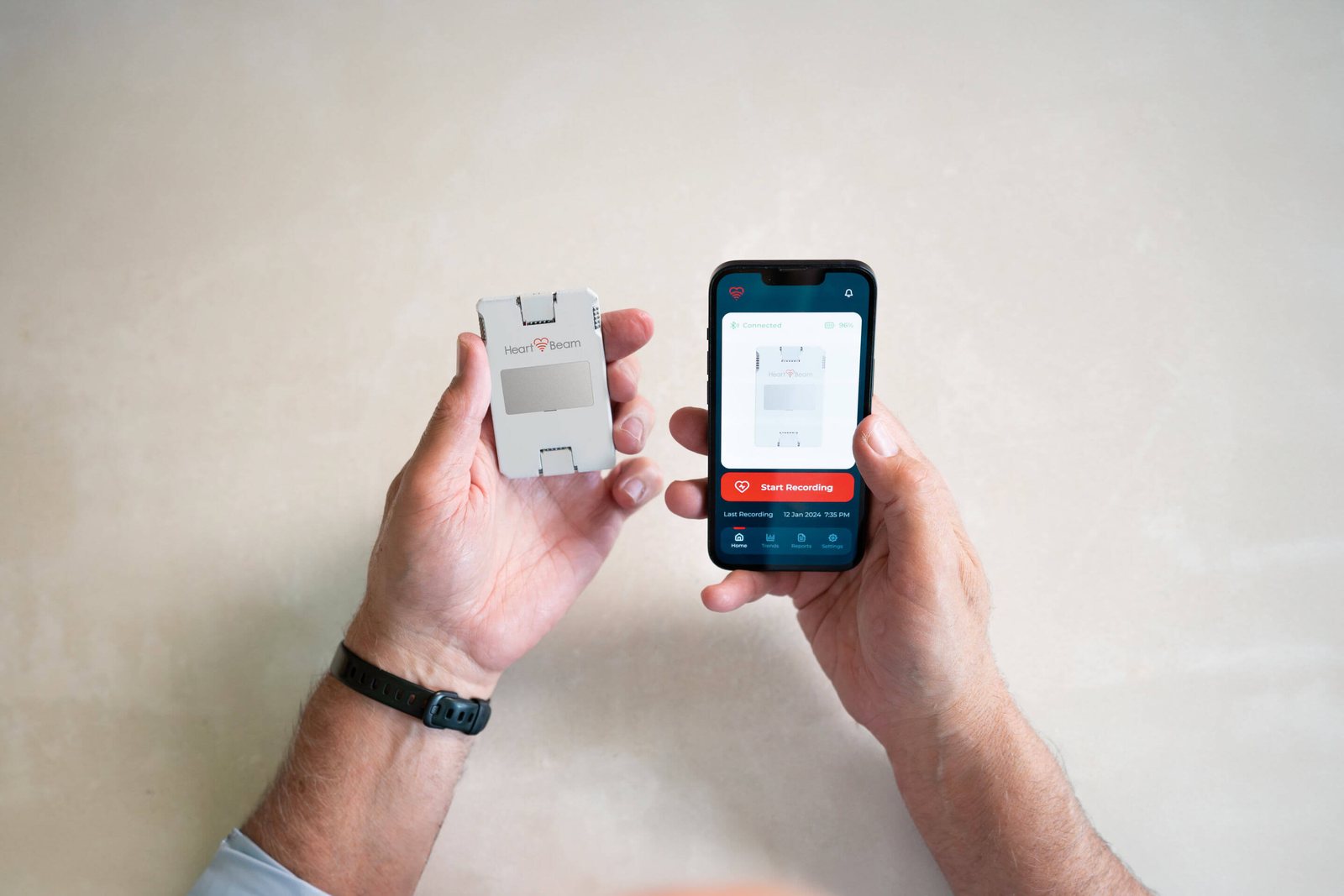


HeartBeam has won FDA Breakthrough Device Designation for teaching its existing 3D-ECG platform a new trick: flagging a possible heart attack before the patient ever reaches a hospital. The Santa Clara, California company announced the designation on 5 October 2026, saying FDA granted it within roughly 30 days of HeartBeam's request — well inside the agency's 60-day statutory review window for the program.
HeartBeam's designation, in four figures
Figures from HeartBeam's 5 October 2026 announcement and its prior FDA clearance and VALID-ECG trial disclosures.
A status, not a clearance
Breakthrough Device Designation does not let HeartBeam market the HeartBeam System for heart-attack assessment. What it grants is priority: more frequent interaction with FDA review staff, and a faster path through the agency's review queue once HeartBeam files for an actual clearance or approval of that indication. The company still has to run the pivotal study it has said is coming, and win a 510(k) clearance, De Novo authorization or PMA of its own for the heart-attack use — separate from the two clearances the underlying technology already holds for arrhythmia assessment.
“One of the biggest gaps in heart attack care today occurs before the patient ever arrives at the hospital.” Tony Das, M.D., HeartBeam Scientific Advisory Board — 5 October 2026 announcement
Three vectors instead of twelve wires
A standard 12-lead ECG needs ten electrodes placed on a patient's chest and limbs, which is why it lives in clinics and ambulances rather than pockets. HeartBeam's device instead records the heart's electrical signals from three non-coplanar vectors through a credit-card-sized, cable-free unit a patient holds against their body, then uses a personalized transformation matrix to synthesize a standard 12-lead ECG from those three signals. In HeartBeam's VALID-ECG trial, the synthesized reading showed 93.4% overall diagnostic agreement with a simultaneously recorded standard 12-lead ECG for arrhythmia detection — the clinical basis FDA has already accepted once, in the December 2024 and December 2025 clearances for that use.
Three reasons FDA fast-tracked a second indication
No cath lab required
The same cable-free, three-vector device a patient already carries for arrhythmia symptoms would, if cleared, extend to heart-attack assessment without new hardware — a software and clinical-evidence problem, not a manufacturing one.
A platform FDA has cleared before
The vector-to-12-lead synthesis technique underlying the heart-attack indication is the same one FDA cleared for arrhythmia assessment in December 2024, then cleared again, as standalone synthesis software, in December 2025 after a successful appeal of an earlier not-substantially-equivalent finding.
A pilot study already in hand
HeartBeam's request leaned on its 134-patient ALIGN-ACS pilot study and data shown at the American Heart Association's 2025 Scientific Sessions, rather than starting the designation process from a blank evidence file.
The 30 minutes before the ambulance
Ambulatory cardiac monitoring — the devices patients wear or carry between hospital visits — is itself a growing category, though researchers disagree sharply on how to size it depending on whether they count hospital-grade patch monitors, consumer wearables, or both. HeartBeam's heart-attack indication, if it clears FDA, would compete for a narrower slice: assessment in the window before a patient reaches an ambulance or emergency department at all, a use case standard ambulatory monitors are not designed or cleared for today.
What ambulatory cardiac monitoring is worth
$6.8B → $12.3B
Global ambulatory cardiac monitoring devices market, 2024 to 2030, as forecast by Global Info Research; a narrower ambulatory-ECG segment estimate from Towards Healthcare puts the same category at $0.74B to $1.12B over a similar window, underlining how differently researchers scope it.
Sources: Global Info Research, Global Ambulatory Cardiac Monitoring Devices Market report · Towards Healthcare, Ambulatory Electrocardiography (ECG) Market Size report
Regulatory News outlook
We read HeartBeam's designation as aimed at a use case neither published estimate above is scoped to measure on its own: pre-ambulance heart-attack assessment, which sits upstream of the ambulatory monitoring category both reports size. If FDA ultimately clears the indication, we'd expect HeartBeam to compete for share of whichever of these two scopes proves closer to how payers and hospitals actually define the category, rather than create a market distinct from both.
How we got here: We take Global Info Research's broader 2024-2030 ambulatory cardiac monitoring devices range ($6.8B to $12.3B, a 10.3% CAGR) as the ceiling case and Towards Healthcare's narrower ambulatory-ECG-only range ($0.74B to $1.12B) as the floor case, without adjusting either forecast, since neither publisher has yet modeled a pre-hospital heart-attack-assessment sub-segment specifically.
Where the HeartBeam System sits against other ECG tools
| Product | Form factor | Setting | US regulatory status |
|---|---|---|---|
| HeartBeam System (HeartBeam) | Cable-free, credit-card-sized, 3-vector synthesis | At-home, pre-hospital | 510(k) cleared for arrhythmia (2024/2025); Breakthrough Device review for heart-attack assessment (Oct 2026) |
| KardiaMobile (AliveCor) | Handheld 1- or 6-lead consumer device | At-home, consumer | FDA cleared, arrhythmia detection (established device) |
| Zio (iRhythm Technologies) | Adhesive patch, 1-lead, up to 14 days | Ambulatory, clinician-prescribed | FDA cleared, arrhythmia monitoring (established device) |
| Standard 12-lead ECG (hospital/EMS) | 10 electrodes, cart or ambulance unit | Hospital, clinic, ambulance | Established diagnostic standard of care |
From each company's own labelling and FDA clearance records; not a clinical comparison. None of these products is cleared for the specific heart-attack-assessment use HeartBeam's designation covers.
From a 2015 founding to FDA's fast lane
HeartBeam's road to a second FDA review
- 2015
HeartBeam founded
Founded in Santa Clara, California, by Branislav Vajdic to develop vector-based, cable-free ECG technology.
- November 2021
Nasdaq listing
Initial public offering on Nasdaq under the ticker BEAT.
- 13 December 2024
First FDA 510(k) clearance
FDA clears the HeartBeam System's 3D-ECG technology for arrhythmia assessment.
- October 2024
Robert Eno named CEO
Eno, previously HeartBeam's President, becomes Chief Executive Officer as the company prepares for US commercialization.
- December 2025
Synthesis software cleared
FDA clears HeartBeam's 12-lead ECG synthesis software, after a successful appeal of an earlier not-substantially-equivalent determination.
- 5 October 2026
Breakthrough Device Designation
FDA grants Breakthrough Device Designation for assessing possible heart attacks outside a hospital, built on the ALIGN-ACS pilot study.
- Ahead
A pivotal study, then a new filing
HeartBeam has said it plans a pivotal study for the heart-attack indication, with further ALIGN-ACS data expected at the TCT conference and from its HEADSTART-ACS study.
What a status does not yet authorize
A Breakthrough Device Designation is a priority ticket through FDA's review process, not a verdict on safety or effectiveness for the new use. HeartBeam has not disclosed the design, size or timeline of the pivotal study it says will support an eventual heart-attack-assessment filing, and the 93.4% diagnostic-agreement figure from VALID-ECG describes the device's accuracy against arrhythmia, the indication it is already cleared for, not heart-attack detection specifically. Until that filing clears FDA, the HeartBeam System remains cleared to help assess arrhythmia symptoms at home — not, yet, a heart attack.
- What changed: FDA granted Breakthrough Device Designation on 5 October 2026 for a new indication — heart-attack assessment — built on HeartBeam's existing, twice-cleared 3D-ECG platform.
- What it does not change: HeartBeam still needs its own FDA clearance or approval for the heart-attack use, following a pivotal study it has not yet detailed.
- Commercial base: the underlying arrhythmia-assessment device is in a limited US commercial rollout with select cardiology groups, with ClearCardio named as a first commercial partner.
- Not yet public: the pivotal study's design, size or expected completion date, and any FDA-assigned designation tracking number, since the program does not maintain a public database of Breakthrough Device grants.
Sources & further reading
- HeartBeam, Inc., “HeartBeam Receives FDA Breakthrough Device Designation for Heart Attack Assessment,” 5 October 2026. ir.heartbeam.com
- Benzinga, “HeartBeam Secures FDA Designation for At-Home Heart Attack Detection System,” 5 October 2026. benzinga.com
- Investing.com, “HeartBeam stock soars on FDA breakthrough designation,” October 2026. investing.com
- HeartBeam, Inc., “HeartBeam Successfully Meets Clinical Endpoints in Pivotal Study for its Groundbreaking 12-Lead ECG Synthesis Technology,” press release. ir.heartbeam.com
- Global Info Research, Global Ambulatory Cardiac Monitoring Devices Market report. giikorea.co.kr
- Towards Healthcare, Ambulatory Electrocardiography (ECG) Market Size report. towardshealthcare.com
Regulatory News reports on public regulatory documents. It is not legal advice, and the primary sources above govern. If we have made an error, we will say so in public: see corrections.
Frequently asked questions
What did FDA actually grant HeartBeam on 5 October 2026?
Breakthrough Device Designation for using the HeartBeam System — the company's existing 3D-ECG vector technology — to assess possible heart attacks (acute coronary syndrome) outside a hospital. FDA granted the designation within about 30 days of HeartBeam's request, well inside the agency's 60-day statutory review window. The designation grants prioritized FDA interaction and review; it is not itself a marketing authorization for the heart-attack use.
Is this HeartBeam's first FDA clearance?
No. The same underlying 3D-ECG platform already holds two FDA 510(k) clearances for a different use — arrhythmia assessment — granted in December 2024 and, for its 12-lead ECG synthesis software, in December 2025. This designation covers a new, separate indication (possible heart attack assessment) that HeartBeam has not yet been cleared or approved to market.
What evidence supports the heart-attack use?
HeartBeam's request cited proof-of-concept data presented at the American Heart Association's 2025 Scientific Sessions and its 134-patient ALIGN-ACS pilot study. The company has said it plans a pivotal study and expects further ALIGN-ACS data at the TCT conference and from its HEADSTART-ACS study.
How does the HeartBeam System work?
It is a cable-free, credit-card-sized device that patients hold to record the heart's electrical signals from three non-coplanar vectors, rather than the ten electrodes a standard 12-lead ECG requires. Software then synthesizes a standard 12-lead ECG from those three vectors; in HeartBeam's VALID-ECG trial, the synthesized reading showed 93.4% overall diagnostic agreement with a simultaneously recorded standard 12-lead ECG for arrhythmia detection.