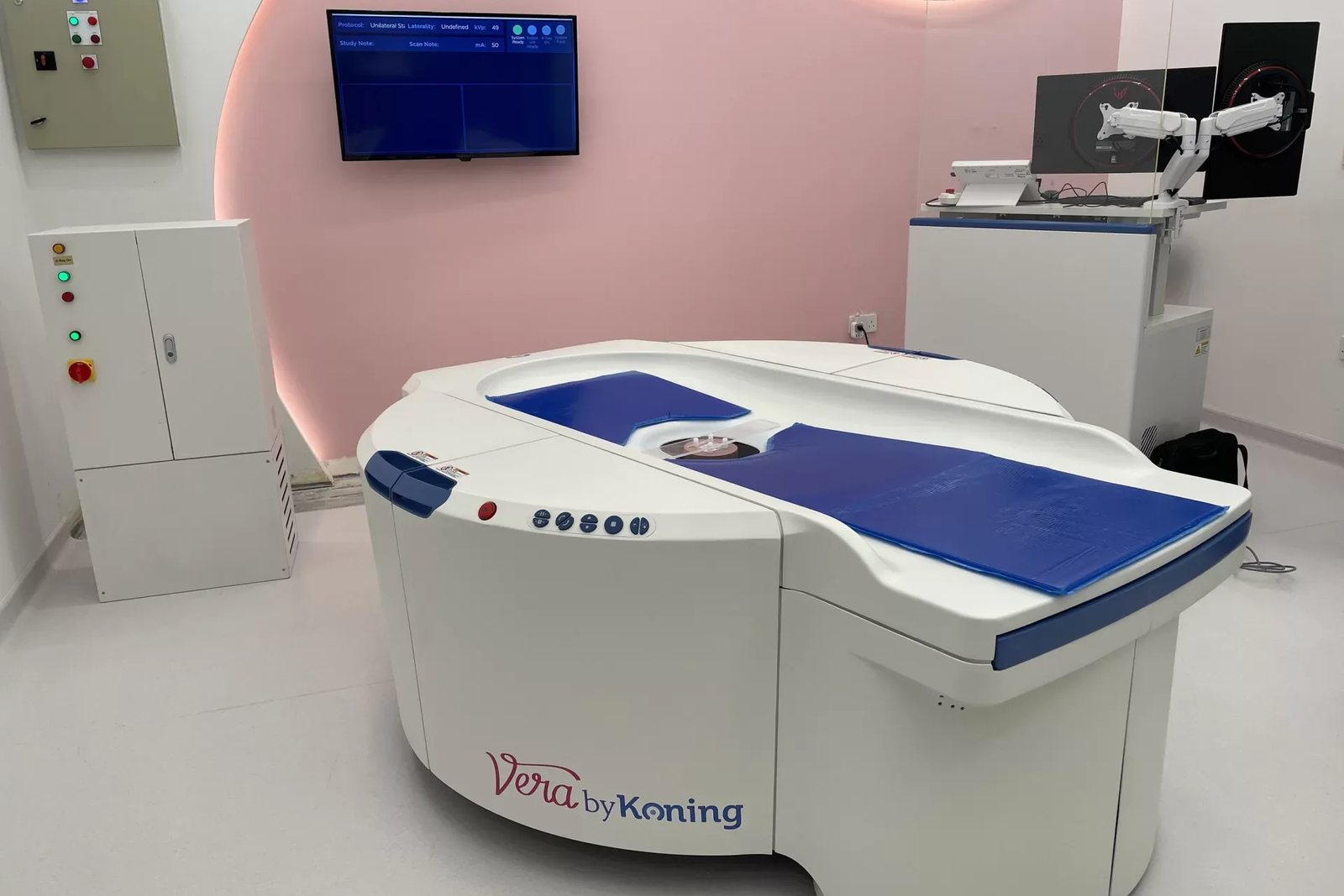
Koning Health has won authorization to sell its Breast CT System in Australia. The country's Therapeutic Goods Administration included the device on the Australian Register of Therapeutic Goods on 8 September 2026, and the Norcross, Georgia company announced the milestone on 18 September, naming Brisbane Radiology as the first Australian provider set to install the compression-free, cone-beam 3D scanner.
A CT scanner built for one organ
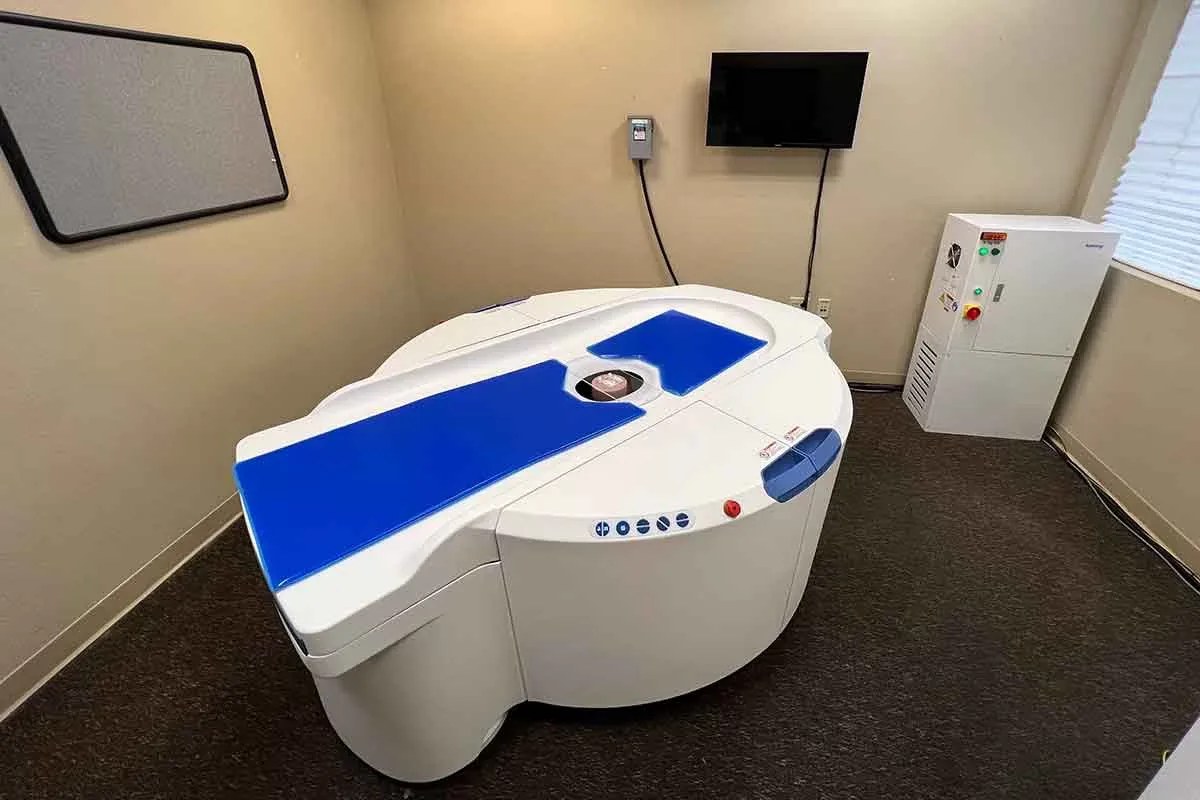
Koning Health's scanner is a dedicated cone-beam CT system: the patient lies prone, the breast hangs pendant through an opening in the table, and a detector rotates around it, acquiring roughly 300 projection images in a single pass with no compression plate. The result is a true, isotropic 3D volume — a dataset that can be sliced and viewed from any plane — rather than the fixed 2D projections of mammography or the narrow-angle sweep of tomosynthesis. FDA approved the underlying technology under a premarket approval, P130025, and Koning has sold it commercially since 2017 as Koning Vera.
Three things the scan changes
No compression, one rotation
The scanner captures a full volumetric image of the breast without the compression plates mammography requires — addressing the single most common patient complaint about breast screening, according to the company.
A true 3D dataset
Because the image is isotropic rather than a 2D projection or a limited-angle sweep, a radiologist can scroll through the breast in any plane, the way a chest CT is read, rather than reconstructing depth from two flattened views.
Dose below a full workup
A peer-reviewed dosimetry study of the system found a typical scan dose around 16 mGy, against up to roughly 32 mGy for a full multi-view diagnostic mammography workup on the same patient.
Eight time zones from Norcross to Brisbane
The ARTG entry itself is dated 8 September 2026; Koning's announcement followed ten days later, on 18 September, naming Brisbane Radiology as the device's first Australian customer. Regulatory News could not independently confirm the Brisbane Radiology detail beyond the companies' own release — no separate statement from the practice was located, and no Australian distributor or installation partner was named.
Australia becomes the fifth market where Koning says its Breast CT System is authorized, following the United States, the European Union under a CE mark, China's NMPA and Health Canada. The company did not publish specific approval dates for those other markets in the material Regulatory News reviewed, so none is asserted here.
“This is an important milestone for Koning and for our continued global expansion. We are grateful to everyone who worked tirelessly to bring this technology to Australia, and we look forward to supporting providers as they introduce a new approach to dedicated breast imaging for their patients.” David Georges, President, Koning — per the company's 18 September 2026 announcement
The Australian approval in four numbers
Figures from the 18 September 2026 announcement and a peer-reviewed dosimetry study (see references).
A crowded mammogram aisle, a near-empty CT one
Koning's scanner competes for capital budgets against an enormous, decades-old installed base: digital mammography and tomosynthesis units sit in nearly every hospital and imaging center performing breast screening, and breast MRI covers the high-risk and problem-solving cases mammography can't resolve. Dedicated breast CT, by contrast, remains a small category with only a handful of cleared systems worldwide — Germany's AB-CT markets a competing spiral, photon-counting scanner, the nu:view, CE-marked in Europe. Koning's approval history gives it a head start in regulatory breadth, but adoption still depends on convincing radiology practices to add, not replace, an imaging modality.
Nine billion dollars, and where breast CT fits
$5.45B → $9.00B
Global breast-imaging market (mammography, tomosynthesis, breast MRI and CT combined), 2024 actual to 2030 forecast, as estimated by Grand View Research and Fortune Business Insights.
Sources: Grand View Research, Breast Imaging Market Size & Share Report · Fortune Business Insights, Breast Imaging Market Size, Industry Share, Forecast
Regulatory News outlook
We expect dedicated breast CT to stay a small but growing slice of that total — on the order of $150 million to $300 million worldwide by 2030 — as a handful of cleared systems compete for budget against an enormous mammography and tomosynthesis base.
How we got here: Applying a 2 to 3 percent share, the range a nascent, multi-vendor imaging category typically holds against an incumbent with decades of installed base and reimbursement history, to Grand View Research's $9.00 billion 2030 breast-imaging forecast.
Koning against the ways a breast gets imaged
| Product | Form | Compression | Typical dose | Regulatory status |
|---|---|---|---|---|
| Koning Breast CT System (Koning Vera) | Dedicated cone-beam CT | None | ~16 mGy per study | FDA, CE mark, China's NMPA, Health Canada and, as of Sept. 2026, Australia's TGA, per company |
| Digital mammography + tomosynthesis | 2D plus limited-angle 3D | Required | Up to ~32 mGy for a full multi-view workup | FDA-cleared; the diagnostic standard |
| Breast MRI | Full 3D, contrast-enhanced | None | No ionizing radiation | FDA-cleared; used for high-risk screening and problem-solving |
| AB-CT nu:view | Dedicated spiral CT, photon-counting | None | Low-dose per company claims | CE-marked in Europe; no FDA clearance identified |
From company statements, FDA and TGA records, and published dosimetry research; not a clinical comparison.
From a Rochester license to a fifth market
Koning's road to Australia
- January 2002
Koning Corporation founded
Incorporated in Delaware, licensing cone-beam breast CT technology developed by Dr. Ruola Ning's team at the University of Rochester.
- 2013
FDA premarket approval
FDA approves the Koning Breast CT system under PMA P130025 for diagnostic breast imaging and 3D-guided biopsy.
- 2017
Commercial launch as Koning Vera
The system reaches the U.S. market commercially under the Koning Vera brand.
- January 2021
Dedicated CPT codes
The American Medical Association authorizes six dedicated breast-CT reimbursement codes.
- 8 September 2026
TGA inclusion on the ARTG
Australia's Therapeutic Goods Administration lists the Koning Breast CT System, ARTG No. 531059, clearing it for commercial supply.
- Ahead
Australian commercialization
Installation and provider education begin with Brisbane Radiology and, per the company, other Australian partners.

What Brisbane Radiology does first
The TGA listing clears the path to sell, not a guarantee of adoption. Koning's own account names one Australian buyer; what comes next is the ordinary work of any new imaging modality entering a market — training radiologists and technologists who have never operated a cone-beam breast scanner, building a reading workflow around isotropic volumes instead of flattened projections, and making the case to Australian payers and hospital budget committees that a compression-free 3D scan is worth adding alongside, not instead of, existing mammography programs.
- Installation: no timeline for Brisbane Radiology's go-live was published in the announcement.
- Distributor: no Australian channel partner was named; Koning says only that it will work with unspecified Australian partners.
- Reimbursement: the announcement does not address how Australian payers or Medicare Benefits Schedule items will treat the scan.
- Installed base: Koning has not published a current global or Australian install count.
Sources & further reading
- Koning Health, “Koning Health Announces Australian Regulatory Approval for Koning Breast CT System,” press release, 18 September 2026. prnewswire.com
- AuntMinnie, “Koning Breast CT System receives Australian TGA approval,” 2026. auntminnie.com
- Medical Device Network, “Koning Health secures Australian TGA approval for breast CT system,” 2026. medicaldevice-network.com
- FDA, Premarket Approval P130025 (Koning Breast CT System). accessdata.fda.gov
- Personalized estimates of radiation dose from dedicated breast CT in a diagnostic population and compared with diagnostic mammography, PMC3872967. ncbi.nlm.nih.gov
- ClinicalTrials.gov, Contrast-Enhanced Cone Beam Breast CT for Diagnostic Breast Imaging, NCT03354611. clinicaltrials.gov
- Grand View Research, Breast Imaging Market Size & Share Report, 2025-2030. grandviewresearch.com
- Fortune Business Insights, Breast Imaging Market Size, Industry Share, Forecast, 2026-2034. fortunebusinessinsights.com
Regulatory News reports on public regulatory documents. It is not legal advice, and the primary sources above govern. If we have made an error, we will say so in public: see corrections.
Frequently asked questions
What did Australia's TGA approve for Koning Health?
The Therapeutic Goods Administration included the Koning Breast CT System (model CBCT 1000) on the Australian Register of Therapeutic Goods, ARTG No. 531059, permitting its commercial supply in Australia. The underlying decision is dated 8 September 2026; Koning announced it on 18 September.
Is Koning's Breast CT System new technology?
No. It is a dedicated cone-beam CT scanner FDA-approved under a premarket approval (P130025) roughly a decade ago and commercialized as Koning Vera since 2017. The Australian authorization is a geographic expansion of an existing, already-commercial product, not a new-product launch.
Who is the first Australian customer?
Brisbane Radiology, according to the companies' announcement. Regulatory News could not independently confirm this beyond the press release; no separate statement from Brisbane Radiology was located.
Is Koning's the only dedicated breast CT scanner?
No. Germany's AB-CT markets a competing dedicated breast CT system, the nu:view, using spiral scanning and photon-counting detectors, CE-marked in Europe. Koning's system is a separate technology with its own FDA approval history.