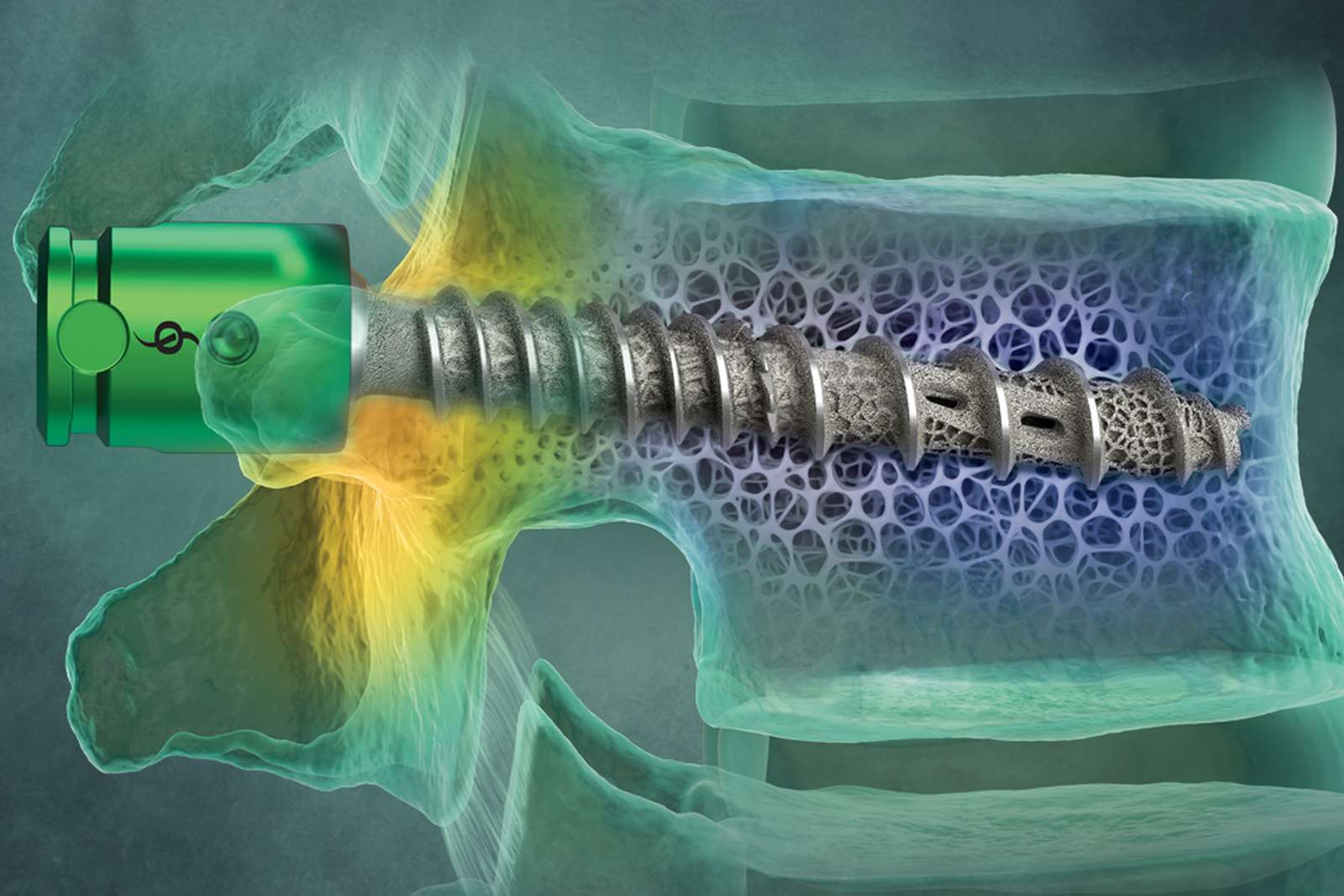


iFuse Granite OnyxWhat to know
30-second read
For Orthopedic Surgery · Neurosurgery
- Who
- Spine surgeons performing multi-level fusion in patients with low bone density — osteoporosis, older age and revision surgery are the recognized risk factors.
- What it does
- A 3D-printed titanium implant for the top and bottom anchor screws of a fusion construct (UIV/LIV), the two points most prone to loosening in soft bone.
- Evidence
- Cleared via FDA’s 510(k) bench-testing pathway, not a clinical trial. SI-BONE cites loosening in up to 27% of constructs, near independent published rates (17–28%).
- What’s different
- SI-BONE’s first compromised-bone implant outside the sacropelvic region; a surface the company says speeds fixation — not yet independently tested.
- Key consideration
- The two surgeons SI-BONE quotes are paid consultants with royalty interests in Onyx, not independent commentary. Third-party rod compatibility is undisclosed.
- Availability
- Cleared September 28, 2026. No launch date, price, CPT code or reimbursement pathway has been announced.
Practice impactNo change to practice yet
A 510(k) clearance built on bench testing and company-cited figures, with commentary only from financially interested surgeons. Worth tracking as commercial and reimbursement details emerge — not yet a reason to change how weak-bone fusion is built.
SI-BONE, Inc. said FDA cleared its iFuse Granite Onyx implant system on 28 September 2026, extending the company's low-bone-density implant platform beyond the sacroiliac joint and pelvis for the first time. Onyx targets the uppermost and lowest screws in a multi-level spinal fusion construct — the two points most likely to loosen when the surrounding bone is soft — and is the third SI-BONE platform to carry an FDA Breakthrough Device Designation. The clearance itself rests on FDA's 510(k) substantial-equivalence pathway: bench testing against a predicate device, not a clinical trial. No 510(k) number, formal indication-for-use text, launch date or price has been made public. The only physician commentary released with the clearance comes from two spine surgeons who are paid consultants to SI-BONE with royalty interests in Onyx itself.
Where fusion constructs actually fail
Multi-level spinal fusion succeeds or fails disproportionately at its two ends. The uppermost instrumented vertebra (UIV) and lowest instrumented vertebra (LIV) carry the greatest mechanical stress in a rod-and-screw construct, and screw loosening there is a well-documented complication in the spine literature. Independent published series report loosening at these levels in roughly the range SI-BONE cites for Onyx — up to 27% of constructs — with more severe (high-grade) loosening specifically linked to a higher chance of hardware revision. Patients with low bone density are the ones most exposed: osteoporosis, older age, and long-segment or revision fusion are the recognized risk factors, and a second operation is exactly the outcome this population can least afford.
What a bench test can and can't tell a surgeon
FDA cleared Onyx through the 510(k) pathway, which requires a manufacturer to show a new device is substantially equivalent to one already on the market — typically through bench and mechanical testing, not a clinical trial. That is standard for an incremental implant like this one, and SI-BONE has not claimed otherwise. But it also means the clearance itself says nothing yet about how Onyx performs in patients. SI-BONE describes the device as built around a “bone-density-specific surface” and an “anatomy-specific thread form” engineered for faster osseointegration and less micromotion in soft bone — company language, not yet the subject of an independent biomechanical study or peer-reviewed clinical series. It is also not yet clear from public information whether Onyx works only with SI-BONE's own rod and screw systems or with other manufacturers' hardware; the company's related Granite system launched with narrower rod compatibility and later won an expanded clearance, a pattern that may or may not repeat here.
Two consultants, two royalty agreements
The two surgeons SI-BONE names in its release are not independent voices. Han Jo Kim, M.D. of the Hospital for Special Surgery and Gregory Mundis Jr., M.D. of Scripps Clinic are both disclosed as paid consultants to SI-BONE with royalty interests in Onyx — meaning they are financially invested in the device they are quoted praising. That is a common and disclosed arrangement in device development, and it does not make their clinical read wrong. It does mean no unconflicted surgeon commentary on Onyx has surfaced yet, and it is worth knowing before treating their quotes as independent validation rather than manufacturer-selected testimony.
What spine surgeons already do for weak bone
Onyx is not entering an empty field. Surgeons managing poor bone quality at construct ends already have established options: cement (PMMA) augmentation through fenestrated or cannulated pedicle screws, which has more than a decade of biomechanical and clinical literature behind it and measurably increases screw pullout strength; longer constructs that redistribute load away from a single weak level; and alternative screw trajectories or designs. None of those options is free of tradeoffs — cement augmentation carries a small risk of cement leakage, for instance — but each carries a track record Onyx does not yet have.
Onyx against today's standard option
| iFuse Granite Onyx | Cement-augmented pedicle screws | |
|---|---|---|
| Regulatory evidence | FDA 510(k) bench/substantial-equivalence testing only | N/A — an established surgical technique, not a single cleared device |
| Independent clinical data | None published yet | More than a decade of biomechanical and outcome literature |
| Mechanism | Bone-density-specific surface and thread form (company description) | PMMA cement injected through a fenestrated screw to anchor in soft bone |
| Known limitation | Compatibility with non-SI-BONE hardware undisclosed | Small risk of cement leakage or extravasation |
Onyx and cement augmentation solve the same problem differently, not head-to-head competitors with comparative trial data; no study has directly compared them.
What's still open
- No commercial launch date, price or CPT code has been announced for Onyx.
- Reimbursement pathway is unconfirmed — whether Onyx rides the new complex-fusion MS-DRG family CMS finalized in 2026, or seeks its own supplemental Medicare payment the way SI-BONE's earlier Granite system did.
- Third-party hardware compatibility is undisclosed; ask before assuming Onyx fits your existing rod and screw system.
- No independent efficacy or safety data exists yet — this is a brand-new clearance with no post-market experience.
Frequently asked questions
Is there clinical trial data behind the Onyx clearance?
No. FDA cleared Onyx through the 510(k) substantial-equivalence pathway, which SI-BONE's own release describes as resting on bench and mechanical testing against a predicate device. No clinical trial, biomechanical study or peer-reviewed data specific to Onyx has been published or referenced by the company.
Does Onyx work with pedicle screw systems from other manufacturers?
Unknown from public information. SI-BONE has not stated whether Onyx is compatible with third-party rod and screw systems or only its own. Its related iFuse Bedrock Granite system launched with narrower rod compatibility and later received an expanded clearance for third-party rods — a pattern that may or may not repeat with Onyx.
Is Onyx covered by Medicare or commercial insurance?
Not yet determined publicly. SI-BONE has not announced a CPT code, a device-specific Medicare payment status, or commercial coverage terms for Onyx. CMS finalized a new MS-DRG family for extensive or complex spinal fusion cases in 2026, partly at SI-BONE's request for Granite, but whether Onyx will fall under it or seek separate payment status is unconfirmed.
Sources & further reading
- Kim et al., screw loosening at the upper and lower instrumented vertebrae in long-segment spinal fusion, J Neurosurg Spine. thejns.org
- SI-BONE, Inc., “SI-BONE Receives FDA 510(k) Clearance for iFuse Granite Onyx™, Extending Its Compromised Bone Franchise Beyond the Pelvis,” 28 September 2026. globenewswire.com
- Orthopedics This Week, independent coverage of the Onyx clearance. orthotw.com
- SI-BONE, Inc., Form 10-K, fiscal year 2025. sec.gov
Regulatory News reports on public regulatory documents. It is not legal advice, and the primary sources above govern. If we have made an error, we will say so in public: see corrections.