
Sling Therapeutics has closed a $123 million Series C financing to carry linsitinib, an oral pill for thyroid eye disease, through its pivotal Phase 3 trial. The Ann Arbor, Michigan company announced the round on 16 September 2026, led by Forbion with participation from existing investor TPG Life Sciences Innovations and new investor Sectoral Asset Management — proceeds earmarked for the ORBIT trial the company designed with FDA after an End-of-Phase 2 meeting earlier this year.
Linsitinib's case in four numbers
Figures from the 16 September 2026 announcement, the January 2025 LIDS trial readout and Amgen's reported financial results.
The $1.9 billion infusion Sling wants to make a pill
Thyroid eye disease has had exactly one approved targeted treatment since 2020: Amgen's Tepezza (teprotumumab), an IGF-1R-blocking antibody infused roughly every three weeks in a clinic, which came to Amgen through its acquisition of Horizon Therapeutics and generated close to $1.9 billion in 2024 sales. Every rival IGF-1R candidate now in development — Viridian's VRDN-003, and others under names like lonigutamab and veligrotug — is also a biologic, given by subcutaneous injection. Linsitinib is the one of the group taken as a pill.
Thyroid eye disease treatment, by one widely cited forecast
$4.94B → $7.55B
Global thyroid eye disease treatment market, 2025 to 2030, as forecast by Mordor Intelligence (9.12% CAGR); other published forecasts for the same period range as low as $1.4 billion, reflecting different market-scope definitions.
Sources: Mordor Intelligence, Thyroid Eye Disease Treatment Market
Regulatory News outlook
If linsitinib reaches approval as the only oral option in a market currently defined by infusions and injections, we expect it to compete primarily on convenience for patients who would otherwise skip or delay infusion visits — a wedge, not a replacement, worth low hundreds of millions of dollars in annual U.S. sales within its first several years on the market.
How we got here: Tepezza's $1.9 billion in 2024 sales is the category's actual revenue base; we assume an oral entrant captures a low double-digit percentage of that base in patients who prefer to avoid infusion visits, without assuming it displaces Tepezza's efficacy-driven core prescriber base. The percentage is our assumption, not the company's.
Linsitinib against the field it would join
| Product | Mechanism | Route | Stage | What the evidence shows |
|---|---|---|---|---|
| Linsitinib (Sling) | Small-molecule IGF-1R inhibitor | Oral, twice daily | Phase 3 ORBIT, FDA Fast Track | LIDS: 52% proptosis response at week 24 on 150mg (p=.01); no hearing-impairment signal reported |
| Tepezza (Amgen) | IGF-1R-blocking antibody | IV infusion, every ~3 weeks | Approved 2020 | Established efficacy; labelled hearing-impairment and hyperglycemia risks |
| VRDN-003 (Viridian) | IGF-1R-blocking antibody | Subcutaneous injection | Phase 3 | Designed as a shorter, self-administered alternative to IV Tepezza |
| Lonigutamab / veligrotug (various) | IGF-1R-blocking antibody | Subcutaneous injection | Phase 2/3 | Earlier-stage injectable candidates in the same target class |
From each company's announcements and published trial data; not a head-to-head clinical comparison.
An oncology molecule with a decade of safety data behind it
Linsitinib did not start as an eye drug. Astellas Pharma originally developed it as an oral IGF-1R inhibitor for cancer, testing it in roughly 800 to 900 patients across some 15 oncology trials before shelving the oncology program. Sling Therapeutics in-licensed the molecule in 2022 specifically to pursue thyroid eye disease, an autoimmune condition in which IGF-1R signalling drives inflammation and tissue expansion behind the eyes — the same receptor Tepezza blocks with an antibody, now targeted by a small molecule a patient swallows.
What a decade of oncology data buys a rare-disease filing
An unusually large safety database for a young biotech asset
Hundreds of prior cancer-trial patients give FDA reviewers exposure data most Phase 3-stage rare-disease drugs do not have at this point in development.
No infusion chair required
As an oral tablet, linsitinib sidesteps the clinic-infusion logistics that limit Tepezza's use to patients who can make repeat visits every three weeks.
A differentiated safety signal in early data
The company reports no significant hearing-impairment or hyperglycemia signal at the 150mg dose in LIDS, against Tepezza's labelled rates for both — though the comparison is across separate trials, not head-to-head.
What $123 million actually buys
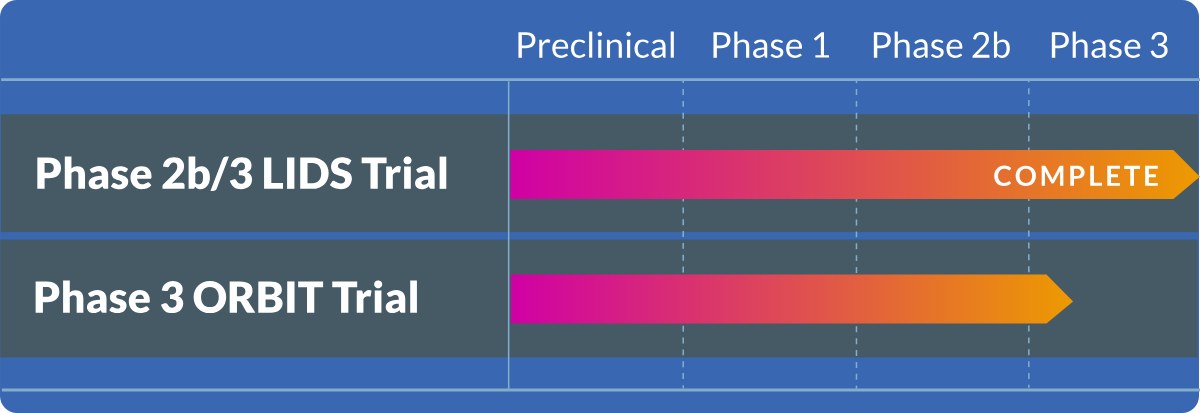
The financing follows an End-of-Phase 2 meeting with FDA earlier in 2026, in which the agency aligned with Sling on the design of ORBIT, the pivotal Phase 3 trial: roughly 130 participants randomized 1:1 to linsitinib 150mg twice daily or placebo for 24 weeks, with the primary endpoint the proportion of patients achieving at least a 2mm reduction in proptosis in the study eye without worsening in the fellow eye, followed by a 24-week open-label extension. Proceeds from the round are earmarked to run that trial and, if it succeeds, to carry the company toward commercialization — the specific financing-and-milestone criterion this Spotlight is built on.
“This financing reinforces our conviction in linsitinib’s potential to transform the treatment landscape for people living with TED as the first and only oral IGF-1R inhibitor in late-stage development.” Ryan Zeidan, Ph.D., President and Chief Executive Officer, Sling Therapeutics — 16 September 2026 announcement
From a 2022 launch to a pivotal readout
Sling's four years on one molecule
- 2022
In-licensed from Astellas
Sling acquires rights to linsitinib, an IGF-1R inhibitor previously tested in oncology, to develop for thyroid eye disease.
- June 2022
Public launch, $35 million Series A
Led by TPG's The Rise Fund, funding the company's initial thyroid eye disease clinical program.
- January 2025
Positive Phase 2b/3 LIDS data
The 150mg dose hits its primary endpoint: 52% proptosis response at week 24 versus placebo (p=.01), in a 90-patient trial.
- Earlier 2026
End-of-Phase 2 meeting with FDA
Agency and company align on the design of the Phase 3 ORBIT trial.
- 16 September 2026
$123 million Series C closed
Led by Forbion, with TPG Life Sciences Innovations and new investor Sectoral Asset Management; Regina Salvat (Forbion) and François Beaubien (Sectoral) join the board.
- Ahead
ORBIT enrollment and readout
Approximately 130 participants, randomized 1:1, 24-week primary endpoint followed by a 24-week open-label extension; timeline for results not yet disclosed.

- Trial design: ORBIT randomizes roughly 130 participants 1:1 to linsitinib 150mg twice daily or placebo for 24 weeks, with a 24-week open-label extension to follow.
- Board additions: Regina Salvat, Ph.D. (Forbion) and François Beaubien, Ph.D., CFA (Sectoral Asset Management) join Sling's board alongside the Series C.
- Designation: linsitinib holds FDA Fast Track designation; the company has not disclosed the exact date it was granted.
What is not yet public: ORBIT's enrollment timeline, an expected data readout date, or how large a confirmatory package FDA will require beyond the single pivotal trial. Sling has also not disclosed how far the $123 million is expected to carry the company's cash runway.
Sources & further reading
- Sling Therapeutics, “Sling Therapeutics Announces $123 Million Series C Financing to Advance Phase 3 Development of its Oral Small Molecule IGF-1R Inhibitor for Thyroid Eye Disease,” press release, 16 September 2026. businesswire.com
- Angus Liu, “Sling reels in $123M Series C funding for its oral Tepezza rival in eye disease,” Fierce Biotech, 16 September 2026. fiercebiotech.com
- “Sling catches $123M Series C for thyroid eye disease pill,” BioSpace, 16 September 2026. biospace.com
- “Sling Therapeutics Announces Positive Topline Results from Phase 2b/3 LIDS Clinical Trial of Oral Small Molecule Linsitinib in Patients with Thyroid Eye Disease,” PR Newswire, 16 January 2025. prnewswire.com
- “Linsitinib for thyroid eye disease shows proptosis reduction, safety in phase 2b/3 trial,” Healio, 16 January 2025. healio.com
- “Sling Therapeutics Launches with $35M Series A Financing to Develop Oral Small Molecule for Thyroid Eye Disease,” PR Newswire, 13 June 2022. prnewswire.com
- Amgen Inc., full-year and fourth-quarter 2024 financial results (Tepezza product sales). amgen.com
- Mordor Intelligence, “Thyroid Eye Disease Treatment Market — Growth, Trends, and Forecasts (2025-2030).” mordorintelligence.com
Regulatory News reports on public regulatory documents. It is not legal advice, and the primary sources above govern. If we have made an error, we will say so in public: see corrections.
Frequently asked questions
What is linsitinib?
An oral, small-molecule IGF-1R (insulin-like growth factor 1 receptor) inhibitor, originally developed by Astellas Pharma as an oncology candidate and tested in roughly 800-900 cancer patients before Sling Therapeutics in-licensed it in 2022 to develop for thyroid eye disease.
What is the Series C financing for?
Sling raised $123 million on 16 September 2026, led by Forbion with TPG Life Sciences Innovations and new investor Sectoral Asset Management, to fund linsitinib through its Phase 3 ORBIT pivotal trial and, if successful, toward commercialization.
What did the Phase 2b/3 LIDS trial show?
In a 90-patient, randomized, double-masked, placebo-controlled study reported in January 2025, the 150mg twice-daily dose met its primary endpoint: 52% of patients achieved at least a 2mm reduction in proptosis in the study eye at 24 weeks, versus placebo (p=.01).
How is linsitinib different from Tepezza?
Tepezza (teprotumumab) is an infused antibody, dosed roughly every three weeks in a clinic. Linsitinib is an oral pill Sling describes as the only IGF-1R inhibitor in late-stage development given by mouth; every other IGF-1R-targeted TED candidate in the current competitive field is administered by injection.