
BigHat Biosciences has closed a $75 million Series C financing, co-led by DFJ Growth and Premji Invest, bringing the company's total funding since its 2019 founding to $223 million. The San Mateo, California biotech announced the round on 24 September 2026, weeks after dosing the first patient in a Phase 1/2 trial of BHB810, an antibody-drug conjugate designed on the AI-and-wet-lab platform BigHat has spent seven years building.
$32 billion by 2033, one gastric program deep
BHB810 is an antibody-drug conjugate, or ADC — a category that has become one of oncology's fastest-growing, built on pairing a targeting antibody with a cell-killing payload. BigHat's bet is not that ADCs are underappreciated; it is that its platform can design better antibody backbones for them, faster, than conventional discovery. BHB810 targets CDH17, a protein expressed on gastric and gastroesophageal junction tumors, and BigHat has published preclinical data showing complete or near-complete tumor clearance across roughly 30 patient- and cell-derived models, including tumors with low or uneven CDH17 expression.
The ADC market BHB810 is entering
$16.7B → $32.1B
Global antibody-drug conjugate market, 2026 estimate to 2033 forecast, as estimated by Grand View Research.
Sources: Grand View Research, Antibody Drug Conjugates Market Size, Share & Trends Analysis Report
Regulatory News outlook
BHB810 competes for a slice of the ADC market's gastrointestinal-cancer segment specifically, not the category total; a successful approval years from now would plausibly reach the low hundreds of millions of dollars in annual sales, not the billions the category-wide figures suggest.
How we got here: Grand View Research's forecast implies roughly $15.4 billion of ADC category growth between 2026 and 2033; gastrointestinal cancers are a minority of the ADC category's current tumor-type mix (breast cancer alone accounts for roughly 41% of 2025 ADC revenue, per the same publisher), so even a strong share of the GI slice of that growth points to a per-drug outcome in the hundreds of millions, not billions, of dollars a year.
BigHat against the other AI antibody labs raising big rounds
| Company | Approach | Funding & status | Clinical stage |
|---|---|---|---|
| BigHat Biosciences | AI models plus an automated wet lab, in a closed design-build-test loop | $223M raised; private | BHB810 dosing in Phase 1/2 (gastric and GEJ adenocarcinoma) |
| Absci | Generative AI antibody design | Public (Nasdaq: ABSI) | First Phase 1 dose, May 2025 |
| Generate:Biomedicines | Generative AI protein and biologics design | ~$750M raised; private | Early-stage pipeline |
| Xaira Therapeutics | End-to-end AI drug discovery, including generative biologics design | ~$1B committed at its 2024 launch; private | Early-stage pipeline |
From each company's own funding and pipeline announcements; not a clinical comparison.
Thousands of antibodies a week, one closed loop
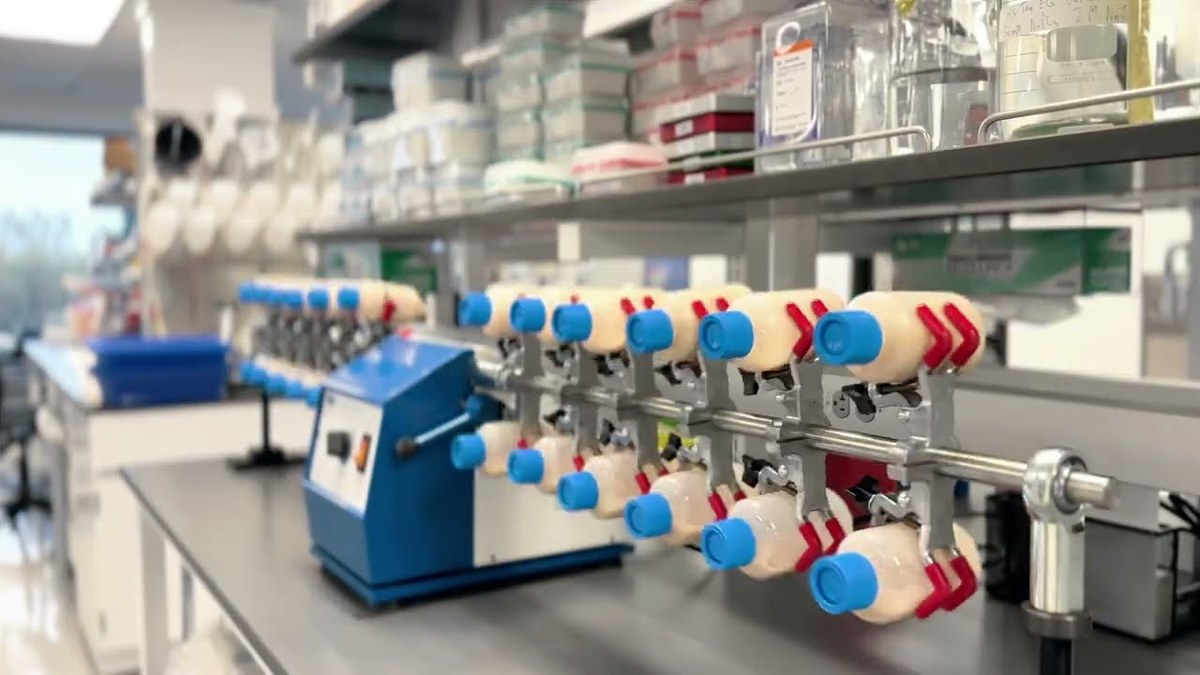
BigHat Biosciences builds what it calls an agentic data platform: an automated wet lab, integrated with AI models, that designs an antibody variant, synthesizes and tests it, and feeds the result back into the model in a continuous loop. The company says the system can design and evaluate thousands of antibody variants each week, screening for binding affinity, solubility, stability and functional activity in cell-based assays before a candidate is ever chosen for further development.
What BigHat is betting the round on
A closed loop, not a model alone
The wet lab generates the training data the AI models learn from, and the AI models pick the next variant the wet lab builds — a design-build-test cycle BigHat says outputs thousands of antibody variants a week.
Five pharma partners already paying to use it
Amgen, Merck, Johnson & Johnson, AbbVie and Eli Lilly have each struck research collaborations with BigHat — external validation, and a revenue source, ahead of any drug BigHat owns outright reaching the market.
A clinical asset, not just a platform pitch
BHB810 is already dosing patients, which the company describes as one of the first AI-designed biologics to reach the clinic — a claim a Series C investor can point to that a platform-only company cannot.
What seventy-five million actually buys
BigHat's own release is explicit that this is not a single-purpose raise: proceeds fund “continued growth” of the data-generation platform “as well as” advancement of the therapeutics pipeline “to key clinical readouts.” That framing matters for how the milestone should be read — it is not, on the company's own account, financing dedicated solely to moving BHB810 through trials, even though that is the piece with the clearest regulatory stakes.
“This financing will help us advance both sides of that mission: our pipeline of BigHat-designed therapeutics, beginning with BHB810, one of the first AI-designed biologics to reach the clinic, and our leading platform for AI-designed biologics.” Peyton Greenside, PhD, Co-Founder and Chief Executive Officer, BigHat Biosciences — 24 September 2026 announcement
DFJ Growth's Justin Kao framed the same split from an investor's side: “This integrated learning loop is a powerful advantage, enabling BigHat to rapidly design and optimize therapeutics with the properties needed for clinical development,” he said, tying the platform's value directly to what it can put into a clinic rather than treating the two as separate bets.
Seven years, four rounds, one drug now in patients
BigHat's road to a $75 million Series C
- September 2019
BigHat Biosciences founded
Mark DePristo and Peyton Greenside found the company in the San Francisco Bay Area to build an automated, AI-integrated antibody design platform.
- February 2021
Series A, $19 million
Led by Andreessen Horowitz, with a16z general partner Vineeta Agarwala joining the board.
- July 2022
Series B, $75 million
Led by Section 32, with Amgen Ventures and Bristol Myers Squibb among the participants; brings total funding to $100 million.
- November 2022 – January 2026
Five pharma collaborations
Research partnerships announced with Merck, Johnson & Johnson, AbbVie, Amgen and, most recently, Eli Lilly's TuneLab platform.
- March 2025
Peyton Greenside becomes CEO
Co-founder Mark DePristo steps down as Chief Executive Officer; Greenside, previously the company's other co-founder, succeeds him.
- September 2026
BHB810 dosed in Phase 1/2
The CDH17-targeted ADC begins dosing its first patient, in a trial for advanced gastric and gastroesophageal junction adenocarcinoma.
- 24 September 2026
Series C, $75 million
Co-led by DFJ Growth and Premji Invest, taking total funding to $223 million.
- Ahead
Clinical readouts
BigHat has not given a timeline for initial BHB810 data or further detail on BHB299, its second named pipeline program.

- BHB810's trial: a Phase 1/2 study (NCT07529808) in advanced gastric and gastroesophageal junction adenocarcinoma; no interim data has been reported.
- BHB299: named in the Series C release as a second pipeline program; BigHat has not published its target or mechanism in a dedicated announcement.
- An unreconciled funding figure: some third-party trackers describe an additional ~$44 million raised in 2025 between the Series B and Series C; Regulatory News could not locate a primary company release confirming that round, and BigHat's own arithmetic across its named rounds does not fully reconcile to its stated $223 million total. We report the company's own $223 million figure as stated.
- No public listing: BigHat remains private; Absci, its most direct AI-antibody-design comparator, is the only company in this field's competitive set that trades publicly.
Sources & further reading
- BigHat Biosciences, “BigHat Biosciences Announces $75 Million Series C Financing to Advance AI-Designed Therapeutics and Leading Agentic Data Platform for Rapid Protein Design,” press release, 24 September 2026. biospace.com
- Axios Pro, “BigHat Biosciences raises $75M for AI drug development,” 24 September 2026. axios.com
- ClinicalTrials.gov, Phase 1/2 study of BHB810 in advanced gastric and gastroesophageal junction adenocarcinoma, NCT07529808. clinicaltrials.gov
- BigHat Biosciences, “BigHat Biosciences Raises $75 Million in Series B Funding to Design Safer, More Effective Antibodies,” 20 July 2022. businesswire.com
- Grand View Research, Antibody Drug Conjugates Market Size, Share & Trends Analysis Report. grandviewresearch.com
Regulatory News reports on public regulatory documents. It is not legal advice, and the primary sources above govern. If we have made an error, we will say so in public: see corrections.
Frequently asked questions
How big was BigHat's Series C, and who led it?
$75 million, announced 24 September 2026, co-led by DFJ Growth and Premji Invest. Named participants include Catalio Capital Management, LG Technology Ventures, Sigmas Group, and existing investors 8VC, Alexandria Venture Investments, Amgen Ventures, Andreessen Horowitz, Discovery Ventures, GRIDS Capital, Intermountain Ventures, Eli Lilly and Company, Merck's Global Health Innovation Fund, Quadrille Capital and Section 32. The company says total funding since its 2019 founding is now $223 million.
What does the money fund?
Both sides of BigHat's business, by the company's own description: continued scaling of its AI and automated wet-lab data-generation platform, and clinical advancement of its therapeutics pipeline, including BHB810 and a second program, BHB299, toward what the company calls key clinical readouts. It is not a financing dedicated solely to clinical development.
What is BHB810?
A CDH17-targeted antibody-drug conjugate BigHat's platform designed, in development for advanced gastric and gastroesophageal junction adenocarcinoma and other gastrointestinal tumors. It began dosing its first patient in a Phase 1/2 trial (NCT07529808) in September 2026, which the company describes as one of the first AI-designed biologics to reach the clinic.
Is BigHat publicly traded?
No. It remains a private, venture-backed company; this financing is an equity round, not a public offering.