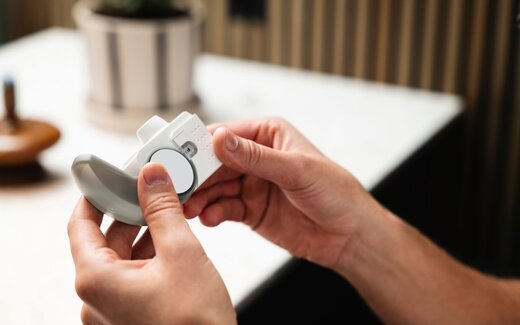


OrthoPediatrics has won FDA 510(k) clearance for the PNP | Femur Retrograde Nail System, a second insertion direction for the pediatric nail platform the Warsaw, Indiana company has sold since 2018. The company announced the clearance on 27 October 2026 alongside its first completed surgical procedures using the device — the same day it reported record third-quarter revenue and raised its full-year guidance.
A father's frustration becomes a Nasdaq company
From one Indiana workshop to a 25-country distributor network
- 2006
OrthoPediatrics founded
Incorporated in Warsaw, Indiana as the first orthopedic company devoted exclusively to children, under founding CEO Mark Throdahl.
- October 2017
Nasdaq listing
Initial public offering at $13.00 per share under the ticker KIDS, raising roughly $46.9 million in net proceeds.
- 2018
PNP Femur launches
The Pediatric Nailing Platform's first femur nail, inserted from the hip, becomes a standard trauma and deformity option.
- June 2022
Agrees to acquire Pega Medical
A deal worth up to $33 million for the Montreal-area maker of the Fassier-Duval Telescopic Intramedullary System, used for osteogenesis imperfecta.
- September 2026
1,000th PNP Tibia nail implanted
The platform's tibial nail surpasses 1,000 recorded implantations.
- 27 October 2026
PNP Retrograde cleared; first cases completed
FDA 510(k) clearance for the Femur Retrograde Nail System, with the company's first surgical procedures already performed the same quarter.
- 2027
Broader U.S. commercialization
Following a limited market release through the remainder of 2026.
What a retrograde nail does that a hip nail can't
OrthoPediatrics built its femur business on PNP | Femur, a nail inserted from the top of the thigh near the hip, in the market since 2018. PNP Retrograde is inserted instead from the knee, a direction surgeons choose for certain fracture patterns and for patients where an antegrade starting point near the hip's growth plate is less desirable. According to the company's 27 October 2026 announcement, the new system ships in anatomic nails built for trauma and straight nails built for deformity correction, in diameters from 7 to 11 millimeters in both designs.
The retrograde system shares instrumentation with the existing Pediatric Nailing Platform femur and tibia systems, so a hospital already stocking PNP hardware does not need a second instrument tray to offer surgeons both insertion directions. OrthoPediatrics said it completed its first procedures with PNP Retrograde the same quarter as the clearance, and plans a limited market release through the rest of 2026 ahead of broader U.S. commercialization in 2027.
“Our Pediatric Nailing Platform has supported nearly 15,000 patients worldwide.” Joe Hauser, President of Trauma and Deformity Correction, OrthoPediatrics — 27 October 2026 announcement
PNP Retrograde in four numbers
Figures from OrthoPediatrics' 27 October 2026 announcement and third-quarter 2026 earnings release.
The $8.5 billion category still sized for adults
Pediatric fracture and deformity care has long leaned on hardware designed for adult bone and scaled down, because the specialty is small relative to general orthopedics. OrthoPediatrics has built its business on the opposite premise: more than 85 products sold in the United States and over 75 other countries, aimed only at children, with no adult product line to subsidize or distract from it. Larger rivals including DePuy Synthes and Stryker sell retrograde femoral nails of their own, built on adult trauma platforms rather than pediatric-specific engineering.
Three things that separate PNP Retrograde from an adapted adult nail
Built for pediatric bone
Diameters from 7 to 11 millimeters, well below the ranges typical of adult retrograde femoral nails, aimed at smaller intramedullary canals and open growth plates rather than a scaled-down adult implant.
Shares existing instrumentation
Built on the same Pediatric Nailing Platform instrumentation as the company's PNP Femur and PNP Tibia systems, already used in roughly 15,000 patients, so a hospital's existing PNP tray supports the new insertion direction.
A pediatric-only distribution network
Sold through a sales organization built around pediatric orthopedics specifically, reaching the U.S. and more than 75 other countries, rather than as one line item in a general trauma catalog.
Pediatric implants, sized to 2030
$3.81B → $8.50B
Pediatric orthopedic implants, 2022 to 2030, as forecast by The Insight Partners, compared with Research and Markets' broader pediatric orthopedic devices forecast for the same year.
Sources: The Insight Partners, Pediatric Orthopedic Implants Market Size and Competitive Analysis by 2030 · Research and Markets, Pediatric Orthopedics market report
Regulatory News outlook
We expect purpose-built pediatric implant makers to keep taking share from adult-hardware-adapted competitors as more hospitals standardize on pediatric-specific instrumentation; OrthoPediatrics' own newly raised 14–16% 2026 revenue growth guidance already outpaces the category's roughly 10–11% forecast rate.
How we got here: The Insight Partners' $3.81 billion 2022 base compounded at its own stated 10.50% CAGR reaches its published $8.50 billion 2030 figure; OrthoPediatrics' $270–273 million 2026 guidance implies 14–16% growth, several points faster than that compounded industry rate.
PNP Retrograde against the hardware it replaces
| Product | Maker | Platform origin | Pediatric-specific | U.S. status |
|---|---|---|---|---|
| PNP | Femur Retrograde | OrthoPediatrics | Purpose-built pediatric nailing platform | Yes | FDA cleared, Oct 2026 |
| T2 Alpha Femur Retrograde Nailing System | Stryker | Adult trauma nail platform | No | FDA cleared, Feb 2026 |
| Retrograde Femoral Nail Advanced System | DePuy Synthes (J&J) | Adult trauma nail platform | No | Established, pre-2026 |
| Natural Nail System Retrograde Femoral Nails | Zimmer Biomet | Adult trauma nail platform | No | FDA cleared, 2010 |
From each company's own FDA 510(k) filings and labelling; not a clinical comparison.
What the 2027 rollout still has to prove
OrthoPediatrics raised its full-year 2026 revenue guidance to $270–273 million the same day it announced the PNP Retrograde clearance, up from $265–269 million, implying 14 to 16 percent growth for the year. Third-quarter revenue reached $72.7 million, up 19 percent, with U.S. revenue of $57.9 million making up 80 percent of the total and scoliosis revenue up 18 percent to $19.2 million. Adjusted EBITDA reached a record $6.9 million for the quarter.
- Limited market release: through the remainder of 2026, with broader U.S. commercialization targeted for 2027.
- Shared instrumentation: PNP Retrograde uses the same trays as PNP Femur and PNP Tibia, already in use for an estimated 15,000 patients.
- Scale: the company surpassed 1,000 PNP Tibia nail implantations in September 2026, a benchmark for how quickly a new PNP system can reach broad adoption.
- Guidance: full-year 2026 revenue guidance raised to $270–273 million, with adjusted EBITDA of roughly $25 million and breakeven free cash flow reiterated.
What is not yet public: the cleared 510(k) number, which FDA's database had not indexed as of this writing, and the specific indicated age or weight range for PNP Retrograde, which the 27 October announcement does not state. We will update this page when the record appears.
Sources & further reading
- OrthoPediatrics Corp., “OrthoPediatrics Announces FDA 510(k) Clearance of PNP | Femur Retrograde Nail System and Completes First Implantations,” press release, 27 October 2026. biospace.com
- Becker's Spine, “OrthoPediatrics wins FDA clearance for pediatric bone implant,” 27 October 2026. beckersspine.com
- OrthoWorld, “OrthoPediatrics Earns 510(k) for PNP Femur Retrograde Nail,” 27 October 2026. orthoworld.com
- OrthoPediatrics Corp., Form 8-K, Third Quarter 2026 Financial Results, 27 October 2026. sec.gov
- OrthoPediatrics Corp., Form 10-K, fiscal year 2017 (IPO terms). sec.gov
- The Insight Partners, “Pediatric Orthopedic Implants Market Size and Competitive Analysis by 2030.” theinsightpartners.com
- Research and Markets, “Pediatric Orthopedics” market report. researchandmarkets.com
- OrthoPediatrics Corp., “OrthoPediatrics to Acquire Pega Medical,” press release, 14 June 2022. ir.orthopediatrics.com
Regulatory News reports on public regulatory documents. It is not legal advice, and the primary sources above govern. If we have made an error, we will say so in public: see corrections.
Frequently asked questions
What did FDA clear for OrthoPediatrics?
The PNP | Femur Retrograde Nail System, a pediatric intramedullary nail inserted from the knee, available in anatomic (trauma) and straight (deformity) designs from 7 to 11 millimeters in diameter. The clearance was announced on 27 October 2026, alongside the company's first procedures using the device.
Is this OrthoPediatrics' first femur nail?
No. The company has sold a femur nail inserted from the hip (PNP | Femur) since 2018, plus earlier PediNail and PediLoc femur systems. PNP Retrograde adds a second insertion direction, sharing the existing PNP platform's instrumentation.
When will PNP Retrograde be widely available?
OrthoPediatrics is running a limited market release through the remainder of 2026, with broader U.S. commercialization planned for 2027.
What is the FDA 510(k) number?
Not yet indexed in FDA's public database as of this writing. We will update this page when the record appears.