

Nouscom has closed an oversubscribed €120 million ($135 million) Series D to fund a single global, registration-enabling trial of NOUS-209, an off-the-shelf vaccine designed to stop cancer before it starts in people who carry Lynch syndrome. The Basel biotech announced the round on 19 October 2026, co-led by M Ventures and Revelation Partners, with new money from Angelini Industries, the European Investment Bank and Neva SGR.
From an Okairos vector platform to Basel
Nouscom's eleven years to a pivotal trial
- 2015
Nouscom founded
Riccardo Cortese and Alfredo Nicosia, both formerly of Okairos (later acquired by GSK), start Nouscom in Basel on the GAd/MVA viral-vector platform, with R&D and manufacturing in Rome.
- 2016–2017
Series A and B
Early rounds totaling roughly €54 million fund the viral-vector neoantigen vaccine platform's first clinical programs.
- January 2023
MSD collaboration
Nouscom signs a clinical trial collaboration and supply agreement with MSD to test NOUS-209 with Keytruda (pembrolizumab) in dMMR/MSI-high metastatic colorectal cancer (NCT04041310); Nouscom keeps worldwide commercial rights.
- November 2023
Series C
An oversubscribed €67.5 million round, co-led by Andera Partners, Bpifrance and M Ventures, later extended to €75.8 million with Angelini Ventures in March 2024.
- 1 June 2026
FDA Fast Track designation
Granted to NOUS-209 for cancer interception in Lynch syndrome carriers.
- 19 October 2026
Series D closes
€120 million ($135 million), funding a single global pivotal trial.
- Ahead
Pivotal trial enrollment
A registration-enabling study in Lynch syndrome carriers, design details not yet fully public.
Sharing 209 neoantigens instead of making one per patient
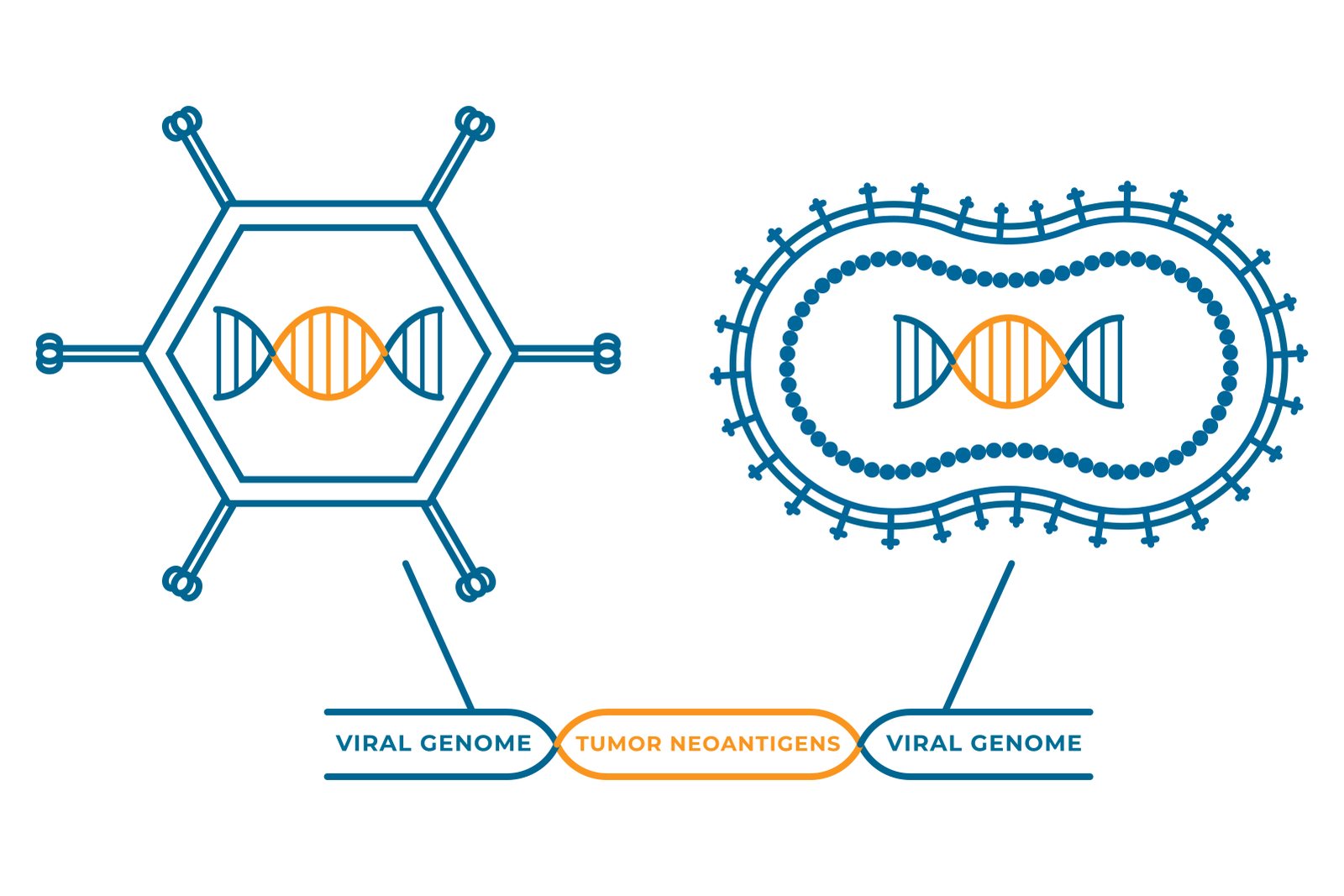
Most of the personalized cancer vaccines now in late-stage trials are built one patient at a time: a tumor is sequenced, its specific mutations identified, and a bespoke vaccine manufactured to match. NOUS-209 takes a different approach. Tumors with mismatch-repair deficiency and microsatellite instability (dMMR/MSI) tend to share a common set of frameshift mutations regardless of the patient, because the same broken repair machinery produces similar errors. Nouscom's vaccine encodes 209 of these shared neoantigens on its viral-vector platform, meaning one manufactured product can, in principle, be given to any patient whose tumor carries the dMMR/MSI signature — no per-patient sequencing or manufacturing step required.
“Over two million LS carriers live with up to an 80% lifetime cancer risk and nothing to offer them but surveillance and surgery… We built Nouscom to change that equation.” Marina Udier, Chief Executive Officer, Nouscom — 19 October 2026 announcement
The Series D in four figures
Figures from Nouscom's Series D announcement and its NCI-sponsored Phase 1b/2 data, presented at ESMO/SITC.
What two years without a control arm shows
The data behind this round come from an NCI-sponsored, MD Anderson-led Phase 1b trial, not a randomized study. Every evaluable Lynch syndrome carrier who received NOUS-209 remained free of advanced adenomas and colorectal cancer, confirmed by colonoscopy, at one year (43 patients) and two years (17 patients) of follow-up. That is a genuinely encouraging signal in a population whose natural history is well characterized enough that oncologists can estimate expected polyp and cancer rates without a trial. It is not, on its own, proof that the vaccine caused the result: without a placebo or surveillance-only control arm, the uncontrolled study cannot rule out that some of these carriers would have stayed adenoma-free regardless. That is precisely the question the new global, registration-enabling trial Series D is funding is designed to answer.
Three things that separate NOUS-209 from treatment-stage rivals
Prevention, not treatment
NOUS-209 targets people who have not yet developed cancer, aiming to intercept it in a defined hereditary population — a different goal from the adjuvant and metastatic settings most personalized cancer vaccines compete in.
No per-patient manufacturing
Because dMMR/MSI tumors share a common set of frameshift neoantigens, one manufactured vaccine lot can serve any eligible patient, unlike fully personalized platforms built from each patient's own tumor sequence.
A defined, identifiable population
Lynch syndrome is a known, testable genetic condition affecting an estimated 1 in 300 people, giving Nouscom a clearly bounded trial population rather than a broad, heterogeneous cancer-risk group.
Personalized rivals, a different goal
The most advanced personalized cancer vaccines — Moderna and Merck's mRNA-4157/V940, and BioNTech and Genentech's autogene cevumeran — work by sequencing each patient's own tumor and manufacturing a bespoke vaccine to match. Moderna and Merck's candidate has shown roughly a 49% reduction in recurrence or death versus pembrolizumab alone in high-risk melanoma, in the adjuvant setting, after disease has already been treated. Neither candidate is designed for cancer prevention in a hereditary, pre-cancer population; Nouscom says it has identified no other company specifically pursuing a vaccine for Lynch syndrome prevention, though it is a claim the company makes about its own category, not one Regulatory News independently verified against every program in development.
A young category, sized three different ways
$0.4B → $23.3B
Published forecasts for the personalized/precision cancer-vaccine market disagree sharply by scope and horizon — from Grand View Research, Global Market Insights and Towards Healthcare.
Sources: Grand View Research, Personalized Cancer Vaccines Market Report · Towards Healthcare, Cancer Vaccines Market Report · Global Market Insights, Cancer Vaccines Market Report
Regulatory News outlook
We think the published forecasts' wide spread mostly reflects how each firm draws the category's boundary — personalized-only versus all cancer vaccines — rather than real disagreement about growth, and we would weight the lower, personalized-vaccine-specific figures more heavily for a prevention-focused product like NOUS-209.
How we got here: We note that Towards Healthcare's $4.2B 2025 figure is roughly ten times Grand View's narrower $1.45B 2030 figure, implying the two firms are counting different sets of products; we have not computed our own dollar estimate for NOUS-209 specifically, since no forecast yet isolates cancer-interception vaccines for hereditary carriers as distinct from treatment-stage personalized vaccines.
NOUS-209 against the personalized vaccines ahead of it in the clinic
| Product | Manufacturing | Setting | Partner | Stage |
|---|---|---|---|---|
| NOUS-209 (Nouscom) | Off-the-shelf, shared neoantigens | Cancer interception, Lynch syndrome carriers | MSD (pembrolizumab, metastatic CRC arm) | FDA Fast Track; global pivotal trial funded |
| mRNA-4157 / V940 (Moderna / Merck) | Fully personalized, per-patient mRNA | Adjuvant, high-risk melanoma | Merck (pembrolizumab) | FDA Breakthrough Therapy; Phase 3 |
| Autogene cevumeran (BioNTech / Genentech) | Fully personalized, per-patient iNeST | Adjuvant and metastatic, several tumor types | Genentech / Roche | Phase 2 |
From each company’s own announcements and public disclosures; not a clinical comparison.
What the pivotal trial still has to show
Nouscom has not yet disclosed the pivotal trial's full design — enrollment target, control arm, or primary endpoint — beyond describing it as a single global, registration-enabling study. That design will determine how convincingly NOUS-209 can separate a real preventive effect from the natural variability of polyp formation in Lynch syndrome carriers, a population oncologists already monitor closely regardless of any vaccine. The company's FDA Fast Track designation, granted 1 June 2026, gives it more frequent agency contact to work through that design, but Fast Track does not relax the bar the pivotal trial will need to clear.
- Financing: €120 million ($135 million) Series D, oversubscribed, co-led by M Ventures and Revelation Partners, with Angelini Industries, the European Investment Bank and Neva SGR joining existing investors.
- Regulatory status: FDA Fast Track designation for NOUS-209 in Lynch syndrome cancer interception, granted 1 June 2026.
- Second track: a separate, MSD-partnered Phase 2 testing NOUS-209 with pembrolizumab in dMMR/MSI-high metastatic colorectal cancer (NCT04041310), where Nouscom retains worldwide commercial rights.
- Open question: the pivotal trial's control arm and primary endpoint, not yet publicly detailed, will decide how directly the early uncontrolled data translate into a registration path.
What the 19 October announcement does not state: a target enrollment number, trial sites, or an expected data readout date for the pivotal study. Regulatory News will update this page once Nouscom discloses the trial's design on ClinicalTrials.gov.
Sources & further reading
- Angus Liu, “Nouscom Raises $135M for Pivotal Trial of Cancer-Preventing Vaccine Candidate,” FierceBiotech, 19 October 2026. fiercebiotech.com
- “Nouscom Secures $135m to Turn the Tide Against Hereditary Cancer,” bioxconomy, 19 October 2026. bioxconomy.com
- “Angelini Ventures and M Ventures Back €120m Nouscom Cancer Immunotherapy Round,” Global Venturing, 19 October 2026. globalventuring.com
- RARE Daily / Global Genes, “Nouscom Raises $135 Million to Advance Cancer Prevention Immunotherapy for Lynch Syndrome,” 19 October 2026. globalgenes.org
- Nouscom, “Nouscom Announces Clinical Trial Collaboration and Supply Agreement with MSD to Evaluate NOUS-209 in Combination with KEYTRUDA (pembrolizumab),” 5 January 2023. nouscom.com
- ClinicalTrials.gov, NOUS-209 plus pembrolizumab in dMMR/MSI-H metastatic colorectal cancer, NCT04041310. clinicaltrials.gov
- Walder Wyss, “Nouscom Raises EUR67.5m ($72m) in Oversubscribed Series C Financing Round,” 15 November 2023. walderwyss.com
Regulatory News reports on public regulatory documents. It is not legal advice, and the primary sources above govern. If we have made an error, we will say so in public: see corrections.
Frequently asked questions
What did Nouscom raise, and what is it for?
An oversubscribed €120 million (about $135 million) Series D, announced 19 October 2026, co-led by M Ventures and Revelation Partners. The company says the proceeds fund a single global, registration-enabling trial of NOUS-209 in Lynch syndrome carriers.
What is NOUS-209?
An off-the-shelf cancer vaccine built on Nouscom's viral-vector platform, encoding 209 neoantigens shared across tumors with mismatch-repair deficiency and microsatellite instability (dMMR/MSI). It does not require per-patient manufacturing, unlike some personalized cancer vaccines.
What is Lynch syndrome, and why target it?
An inherited condition, affecting roughly 1 in 300 people, caused by mismatch-repair gene mutations that sharply raise lifetime cancer risk, particularly colorectal and endometrial cancer. Current management is surveillance and, often, preventive surgery — not prevention itself.
Does the early data prove NOUS-209 prevents cancer?
Not yet. In an uncontrolled Phase 1b/2 study, evaluable Lynch syndrome carriers who received NOUS-209 remained free of advanced adenomas and colorectal cancer at one and two years of colonoscopy follow-up. Without a control arm, that cannot establish prevention — which is what the new pivotal trial is designed to test.