
Solventum has won FDA 510(k) clearance to use its Restrata synthetic wound matrix together with its V.A.C. negative-pressure therapy — the first clearance to formally join the two technologies the Eagan, Minnesota company has been assembling since it bought Restrata's maker, Acera Surgical, for $725 million last December. The company announced the clearance on 19 October 2026.
What structural support and suction have in common
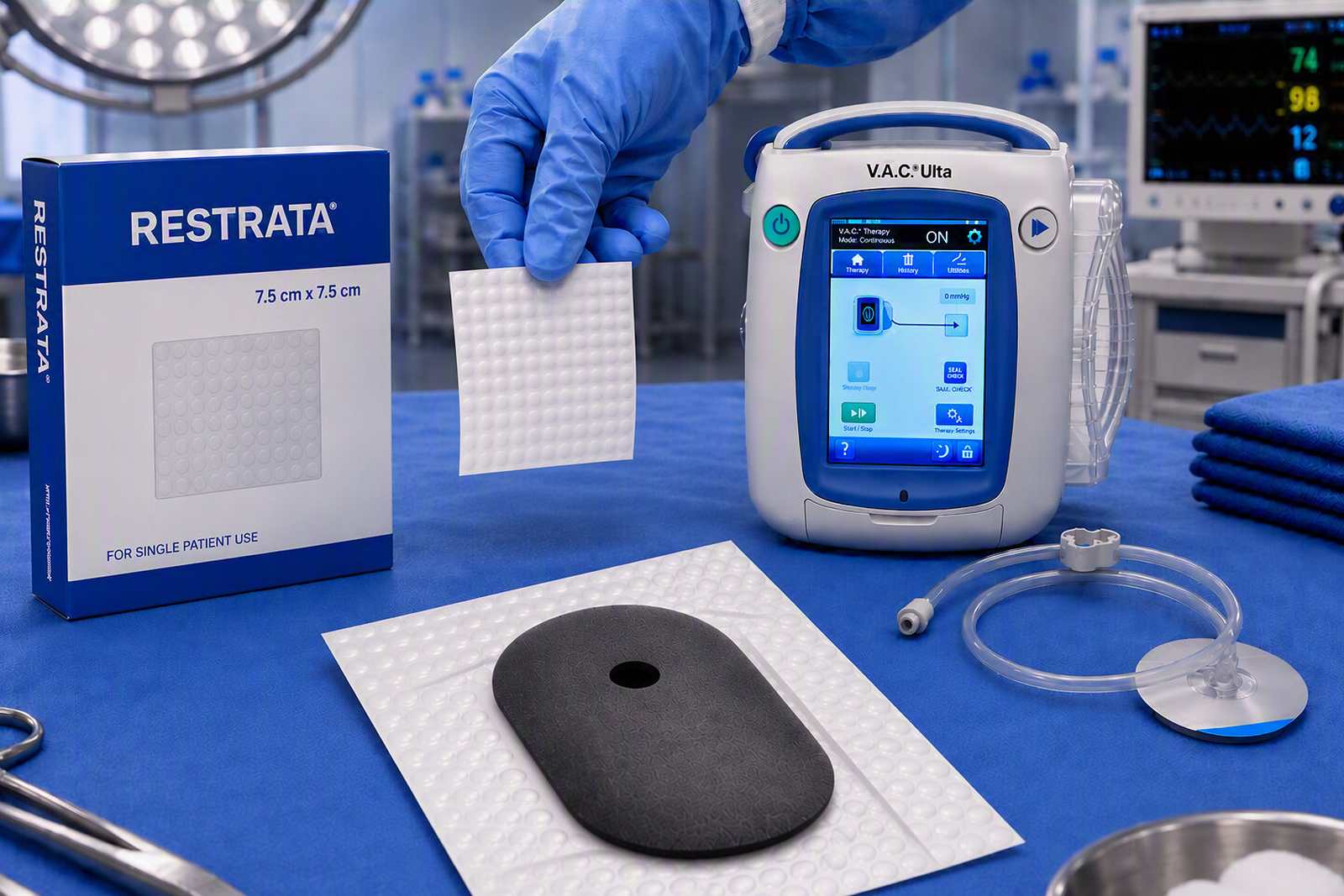
Restrata is a scaffold, not a drug or a biologic. Solventum describes it as a 100% synthetic, fully resorbable electrospun fiber matrix that gives soft tissue structural cues to heal around, rather than delivering growth factors the way some biologic skin substitutes do. V.A.C. Therapy, the negative-pressure wound system Solventum inherited from 3M's acquisition of Kinetic Concepts, works by a different mechanism entirely: controlled suction that draws wound edges together and removes exudate. Used separately, each addresses one piece of a difficult wound. Used together, under this clearance, the negative pressure keeps Restrata pressed against the wound bed for up to seven days at a time, through the V.A.C. Peel and Place Dressing, rather than the matrix sitting loose beneath a conventional cover dressing.
Three things the combined-use label changes
A scaffold that stays put
Negative pressure holds Restrata against the wound bed for up to seven days per application, instead of relying on a static dressing to keep contact.
No growth factors required
Restrata's resorbable fiber structure gives cells a scaffold to build on without the biologic growth factors some skin substitutes depend on, which can simplify sourcing and storage.
One clinical workflow, two platforms
Clinicians already trained on V.A.C. Therapy, the market's long-standing negative-pressure system, gain an on-label path to add Restrata rather than treating the two as separate, uncoordinated choices.
The clearance in four figures
Figures from Solventum's and Acera Surgical's public disclosures.
“…giving clinicians an effective way to streamline care and support better patient outcomes…” Kelley Moffett, President, Advanced Wound Care, Solventum — 19 October 2026 announcement
What a $725 million deal was for
Solventum's acquisition of Acera Surgical, announced in November 2025 and closed that December, was never only about adding a product line. Restrata already held two FDA clearances of its own, in 2017 and 2020, as a standalone synthetic wound dressing generating roughly $90 million in annual sales at the time of the deal. What Solventum could not buy off the shelf was a clearance that let Restrata and its own decades-old V.A.C. Therapy franchise work together on one label. That is what the 19 October 2026 clearance supplies: not a new device, but formal permission to combine two devices Solventum already controlled, each previously cleared only on its own.
A scaffold market still finding its edges
Solventum's own release pegged the U.S. synthetic tissue-matrix segment at roughly $900 million, citing analysis from Stifel — a category narrower than the broader skin-substitutes market analysts track, which third-party research firms put at roughly $1.5 billion in 2024, growing toward $2.2 to $2.4 billion by 2030 at mid-single-digit to high-single-digit annual growth. Neither figure isolates the market this specific combined-use clearance addresses, which is smaller still: patients already being treated with negative-pressure therapy who could also benefit from a synthetic scaffold, a subset analysts have not separately sized.
Sizing the gap between scaffold and segment
$0.9B → $2.2B–$2.4B
Solventum's own cited U.S. synthetic tissue-matrix estimate (via Stifel) against third-party forecasts for the broader global wound skin-substitutes market by 2030.
Sources: Solventum / Acera Surgical acquisition announcement, citing Stifel analysis · Global Information Inc., Wound Skin Substitutes Market Report
Regulatory News outlook
We expect the combined-use clearance to expand Restrata's addressable market within Solventum's existing V.A.C. Therapy install base faster than it grows the broader synthetic-matrix segment on its own, since the clearance's main effect is removing a workflow barrier for clinicians who already use both products.
How we got here: We start from Solventum's own $900 million U.S. synthetic-matrix figure as the category Restrata already competes in, and note that V.A.C. Therapy's large existing hospital footprint is the more plausible near-term growth lever for a combined-use label than new category growth, which third-party skin-substitute forecasts put at roughly 7% a year through 2030.
Restrata against the scaffolds it shares shelf space with
| Product | Composition | Mechanism | Growth factors | U.S. clearance |
|---|---|---|---|---|
| Restrata (Solventum / Acera) | 100% synthetic electrospun fiber | Structural scaffold for tissue formation | None | 2017 (standalone); 2026 (combined use with V.A.C. Therapy) |
| Integra Bilayer Wound Matrix | Bovine collagen and shark glycosaminoglycan | Bilayer dermal regeneration template | None (biologic scaffold) | Long-established, multiple indications |
| MatriDerm | Bovine collagen and elastin | Acellular dermal scaffold | None | Used with earlier autograft coverage in select settings |
From each company’s own labelling and public materials; not a clinical comparison.
From a 3M spinout to a wound-care portfolio play
Solventum's wound-care build-out
- April 2024
Solventum spun off from 3M
Became an independent, publicly traded company on the NYSE as SOLV, inheriting 3M's V.A.C. Therapy negative-pressure franchise.
- November 2025
Acera Surgical acquisition announced
$725 million cash, plus up to $125 million in contingent payments, for Restrata's developer.
- December 2025
Acera deal closes
Restrata, already twice FDA-cleared as a standalone matrix, joins Solventum's Advanced Wound Care portfolio.
- 19 October 2026
Combined-use clearance
FDA clears Restrata Matrix for use together with V.A.C. Therapy, including the Peel and Place Dressing.
- Ahead
Commercial rollout
Clinical adoption across Solventum's existing V.A.C. Therapy hospital accounts, subject to formulary and purchasing decisions.
What this clearance leaves unanswered
A 510(k) clearance for combined use establishes that FDA considers the pairing substantially equivalent to existing, separately cleared devices used together — it is not, on its own, outcomes data. Solventum's release does not cite a comparative clinical trial measuring healing rates for the combination against either product used alone, and the official 510(k) number for this specific combined-use clearance was not located in any FDA database search; this article will update with the K-number once it is indexed. One industry commentary on the clearance noted that the real clinical benefit will only be established through outcomes data collected as clinicians adopt the combination in routine practice.
- What's cleared: combined use of Restrata Synthetic Electrospun Fiber Matrix with the V.A.C. Ulta Therapy Unit, Peel and Place Dressing and Kit, and Granufoam Dressing and Kit.
- What's not yet public: the specific 510(k) number for this combined-use clearance, and any comparative healing-outcomes data for the pairing versus either product alone.
- Scale: Acera generated roughly $90 million in Restrata sales in 2025, against a U.S. synthetic tissue-matrix segment Solventum has put at about $900 million.
- Next milestone: commercial uptake across hospitals already running V.A.C. Therapy, the install base the combined-use label was built to unlock.
Sources & further reading
- Solventum, “Solventum Announces FDA 510(k) Clearance for Combined Use of Restrata™ Matrix and Solventum™ V.A.C.® Therapy,” press release, 19 October 2026. prnewswire.com
- Solventum investor relations copy of the same release. investors.solventum.com
- Dow Jones Newswires via Morningstar, “Solventum Secures FDA Clearance for Combined Wound Care Technologies,” 19 October 2026. morningstar.com
- Indian Pharma Post, “Solventum to Acquire Acera Surgical in $725 Million Deal,” November 2025 (citing Stifel analysis of the U.S. synthetic tissue-matrix market). indianpharmapost.com
- Global Information Inc., Wound Skin Substitutes Market Report, global forecast to 2030. giikorea.co.kr
- 510(k) database record, Restrata (K193583), FDA clearance decision, 25 September 2020. 510kdatabase.net
Regulatory News reports on public regulatory documents. It is not legal advice, and the primary sources above govern. If we have made an error, we will say so in public: see corrections.
Frequently asked questions
What did FDA clear for Solventum?
510(k) clearance for the combined use of Solventum's Restrata Synthetic Electrospun Fiber Matrix with its V.A.C. Therapy negative-pressure system (the V.A.C. Ulta Therapy Unit, Peel and Place Dressing and Kit, and Granufoam Dressing and Kit), announced 19 October 2026.
What is Restrata?
A 100% synthetic, fully resorbable electrospun fiber matrix that supports soft-tissue healing through structural cues rather than biologic growth factors. Solventum acquired it, along with its developer Acera Surgical, for up to $850 million in December 2025.
How long can the combination stay in place?
Up to seven days per application, maintaining matrix-to-wound-bed contact, using the V.A.C. Peel and Place Dressing — longer than Restrata's standalone labeling without negative-pressure support.
Does this clearance cover a new device?
No. Both Restrata and V.A.C. Therapy were separately cleared before (Restrata as early as 2017). This October 2026 clearance covers their combined, on-label use together, which previously was not explicitly authorized.