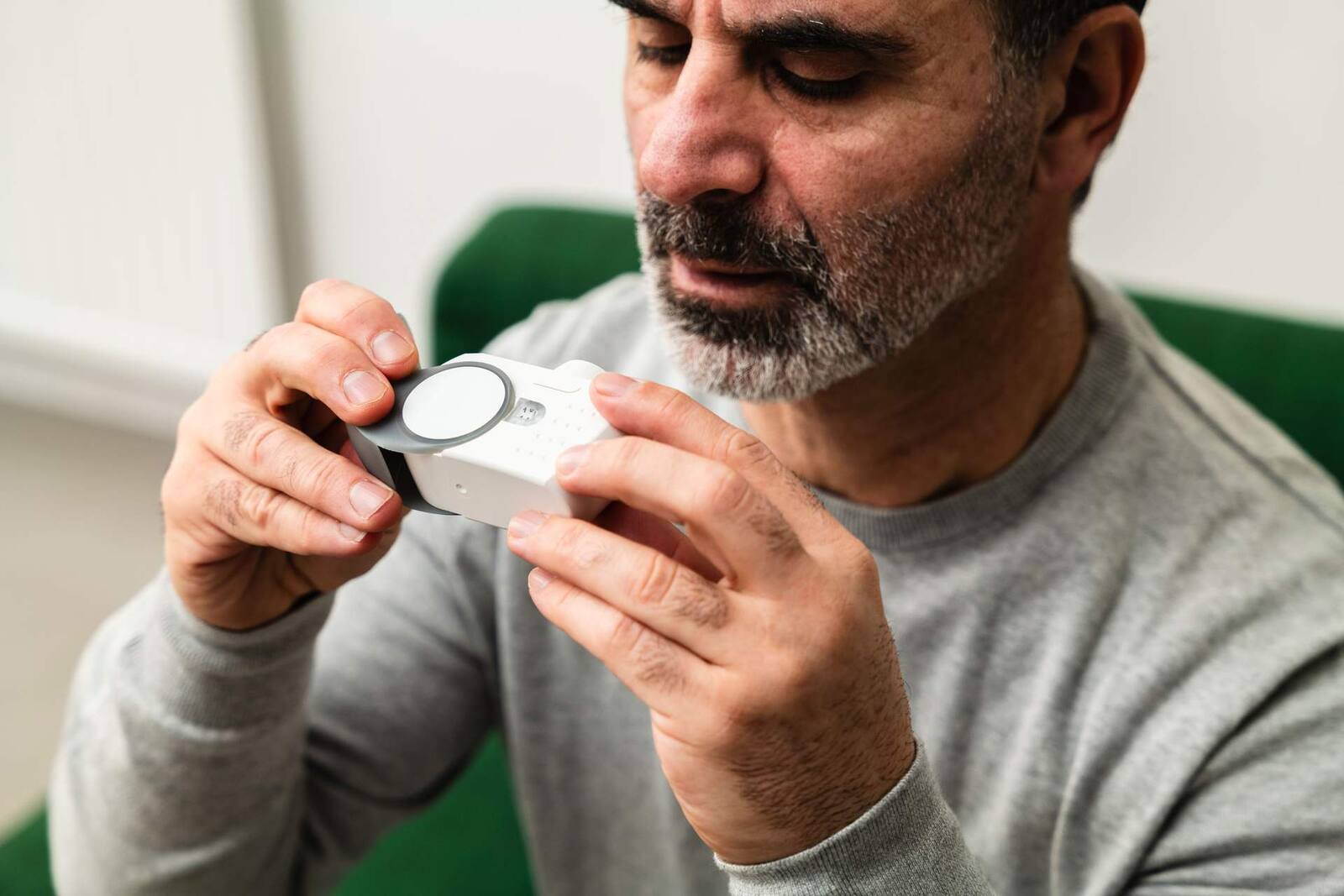


Optune Pax (Tumor Treating Fields)What to know
30-second read
For Oncology · Gastroenterology · General Surgery
- Who
- Adults with unresectable, locally advanced pancreatic cancer starting first-line gemcitabine plus nab-paclitaxel (GnP) chemotherapy.
- What it does
- Four skin arrays deliver continuous 150 kHz electric fields over the abdomen, disrupting cancer-cell division non-invasively alongside chemotherapy.
- Evidence
- PANOVA-3 (571 patients): median overall survival 16.2 vs 14.2 months with GnP alone (HR 0.82, p=0.039); 18.3 vs 15.1 months in patients who wore it ≥28 days.
- What’s different
- An add-on to chemotherapy, not a drug or a replacement. Approved in the US (Feb 2026), EU (Jun 2026) and now Japan (1 Oct 2026); never tested against FOLFIRINOX.
- Key consideration
- Benefit tracks wear time closely; reported median use was only about 62% of the roughly 18 hours a day the device targets. Grade ≥3 skin reactions in 7.7%.
- Availability
- On the US market since February 2026; requires Novocure’s device-training course before first use. Medicare coverage for this indication is not confirmed.
Practice impactConsider as add-on; confirm coverage
A real, modest survival gain added to GnP, a weaker backbone than FOLFIRINOX, which this device was not tested against. Worth raising for patients already planned for GnP who can commit to daily wear and training; confirm coverage first.
Japan's Ministry of Health, Labour and Welfare approved Novocure’s Optune Pax on 1 October 2026 for unresectable, locally advanced pancreatic cancer — the device’s third major-market authorisation this year, after the FDA in February and the EU’s CE Mark in June. For a US oncologist, the practice-relevant fact is not the Japan news; it is that a wearable, non-drug addition to standard chemotherapy has already been available to prescribe for eight months, with a trial record that rewards close reading rather than a press release summary.
A cancer that chemotherapy alone has not moved much
Locally advanced pancreatic cancer sits in an uncomfortable middle: too extensive for upfront resection, not yet metastatic. Japan’s National Cancer Center put the disease’s overall five-year survival rate at about 10% in a November 2025 report describing no significant improvement over time — among the lowest of any cancer type the registry tracks. Gemcitabine plus nab-paclitaxel (GnP) is a standard first-line backbone for patients who are not candidates for more intensive regimens, and it is the chemotherapy Optune Pax was studied alongside, not a substitute for FOLFIRINOX or any other regimen.
What wearing the device actually involves
Tumor Treating Fields are low-intensity, alternating electric fields delivered non-invasively through four arrays applied to the skin over the abdomen, tuned to 150 kHz for pancreatic cancer — the same frequency Novocure uses for lung cancer, against 200 kHz for its glioblastoma and ovarian cancer devices. The company’s published science describes the fields as disrupting mitotic spindle formation during cell division, a physical mechanism distinct from chemotherapy’s chemical action, though Novocure’s own materials acknowledge open questions about the precise mechanism. In practice, the device is designed to be worn close to continuously — commonly reported at around 18 hours a day across Novocure’s other indications — with the arrays changed and repositioned by the patient or a caregiver several times a week. Patients must complete Novocure’s training course before starting; this is not a device a clinic can hand a patient and expect correct use without it.
What PANOVA-3 showed, and what it didn’t test
The approval rests on PANOVA-3, a 571-patient randomised trial presented at ASCO in May 2025 and published simultaneously in the Journal of Clinical Oncology. In the intent-to-treat population, median overall survival was 16.2 months with Optune Pax added to GnP, against 14.2 months with GnP alone — a statistically significant gain (hazard ratio 0.82, 95% CI 0.68–0.99, p=0.039). One-year survival was 68.1% against 60.2%. Time to pain progression, a meaningful secondary endpoint in a disease defined by pain burden, extended to 15.2 months from 9.1.
The detail that should shape how a physician discusses this with a patient is adherence. Among patients who used the device for at least 28 days — a per-protocol, adherence-based analysis, not the primary result — median overall survival widened to 18.3 months against 15.1. Trade-press summaries of the trial report median actual wear time around 62% of the roughly 18-hour daily target, well short of full compliance. That is not a criticism of the device; it is the real-world condition the approval’s headline survival number was achieved under, and it means the benefit a specific patient sees will plausibly depend on how consistently they actually wear it, not just on being prescribed it.
Where Optune Pax sits against pancreatic cancer’s chemotherapy options
| GnP + Optune Pax | GnP alone | FOLFIRINOX | |
|---|---|---|---|
| Median overall survival | 16.2 months (PANOVA-3, HR 0.82, p=0.039) | 14.2 months (PANOVA-3 control arm) | 24.2 months (separate pooled analysis, not a head-to-head trial) |
| What it adds to GnP | A worn device, training and daily skin care | Nothing — the comparator arm | A different, more intensive four-drug regimen |
| Regulatory status | Approved: US (Feb 2026), EU (Jun 2026), Japan (Oct 2026) | Long-approved standard regimen | Long-approved standard regimen |
| Tested against each other? | No — only against GnP alone | Reference comparator in PANOVA-3 | Not studied against Optune Pax in any trial |
FOLFIRINOX’s figure comes from a separate pooled analysis of its own trials, not a trial against Optune Pax or GnP, so none of these numbers are directly comparable across rows. Prescribe from each regimen’s own evidence, not this table.
What changes at the point of care
- Patient selection. Unresectable, locally advanced disease already planned for first-line GnP — not metastatic disease, and not a patient on FOLFIRINOX or another regimen this device has not been studied with.
- Set expectations on adherence. The 16.2-month median reflects real-world wear averaging well under the roughly 18-hour daily target; a patient who understands that wear time plausibly tracks benefit may be more motivated to sustain it.
- Training is not optional. Novocure’s device-training course precedes first use; build the referral and scheduling time for it into the treatment plan, not as an afterthought once chemotherapy starts.
- Skin monitoring. Grade 3 or higher skin reactions under the arrays occurred in 7.7% of patients; a practice offering this device needs a plan for array-site skin checks, not just oncology follow-up.
- Confirm coverage before committing a patient. Medicare’s existing TTFields coverage was built for glioblastoma; whether or how it extends to this indication is not established in the public record, and a patient should not start training on the assumption that it will be paid for.
The honest summary is that Optune Pax adds a real but modest survival benefit to a chemotherapy backbone that is not, by itself, the most aggressive option available for a fit patient. It was never tested against FOLFIRINOX, so it answers a narrower question than “does this beat the best regimen” — it answers “does adding this device to GnP beat GnP alone,” and on that question the trial is clear. What a practice takes on is training, daily skin monitoring, and an adherence conversation with the patient that the trial data make unusually concrete: wear time is not a formality here, it is plausibly the difference between the 14.2-month and the 18.3-month number. Confirm coverage before any of that starts.
Frequently asked questions
Which patients does Optune Pax's approval actually cover?
Adults with unresectable, locally advanced pancreatic cancer, starting first-line gemcitabine and nab-paclitaxel (GnP) chemotherapy. It is approved as an addition to that chemotherapy, not a replacement for it, and not for metastatic disease or for use with other chemotherapy regimens such as FOLFIRINOX, which was not studied in the pivotal trial.
How much does adherence matter?
A great deal. In the intent-to-treat population, median overall survival was 16.2 versus 14.2 months. Among patients who used the device for at least 28 days, the gap widened to 18.3 versus 15.1 months. Trade-press summaries of the trial report median actual usage around 62% of the roughly 18 hours a day the device is designed for — well short of full compliance, which is itself informative for setting expectations with a patient.
Is Optune Pax covered by Medicare for this indication?
Not confirmed. Medicare's existing coverage for Novocure's TTFields devices (HCPCS code E0766) was built around newly diagnosed and recurrent glioblastoma; whether and how that coverage, or a new determination, extends to the pancreatic cancer indication has not been established in the sources available to this report. Treat reimbursement as an open question to resolve before a patient commits to training, not an assumption.
Sources & further reading
- Novocure, “U.S. FDA Approves Novocure’s Optune Pax® for the Treatment of Locally Advanced Pancreatic Cancer,” 11 February 2026. businesswire.com
- Novocure Limited, “Novocure’s Optune Pax® Receives Approval in Japan for the Treatment of Unresectable Locally Advanced Pancreatic Cancer,” SEC Form 8-K Exhibit 99.1, 1 October 2026. sec.gov
- ClinicalTrials.gov, PANOVA-3, NCT03377491. clinicaltrials.gov
- Novocure, PANOVA-3 full data presentation at the ASCO Annual Meeting, 31 May 2025, simultaneously published in the Journal of Clinical Oncology. sec.gov
- Adnkronos, “Japan 5-Year Pancreatic Cancer Survival Rate at 10.2-10.7 Pct,” citing Japan’s National Cancer Center, 19 November 2025. english.adnkronos.com
- Regulatory News, “Novocure Wins Japan Approval for Pancreatic Cancer Device” — this desk’s report on the Japan approval, market sizing and company history. regulatorynews.com
Regulatory News reports on public regulatory documents. It is not legal advice, and the primary sources above govern. If we have made an error, we will say so in public: see corrections.