

Sensydia closed an oversubscribed initial round of more than $6 million on 13 October 2026, led by Colle Capital Partners with support from Orlando Health Ventures, to complete the pivotal study its Cardiac Performance System needs before FDA will consider authorizing the device's full set of non-invasive heart measurements.
What Colle Capital is buying into
Figures from Sensydia's 13 October 2026 announcement and its FDA regulatory history.
Eleven years to one pivotal study
Sensydia's road to ACOUSTIC-1
- 2015
Sensydia founded
Founded in Los Angeles by cardiologist Dr. Aman Mahajan, who remains the company's Chief Medical Officer, to develop a non-invasive alternative to catheter-based hemodynamic measurement.
- 2018
First FDA clearance
FDA cleared CPS for non-invasive measurement of ejection fraction — the company's first authorized claim.
- October 2019
Anthony Arnold named CEO
Arnold joined as President and CEO, bringing more than 20 years of medtech leadership from Smith+Nephew, Medtronic, Boston Scientific and SetPoint Medical.
- January 2022
Breakthrough Device designation
FDA granted Breakthrough Device designation for CPS's broader hemodynamic measurements, including pulmonary artery pressure, beyond the cleared ejection-fraction claim.
- May 2023
$8 million round
Sensydia raised about $8 million led by Orlando Health Ventures, with Colle Capital Partners participating, alongside NIH grant funding.
- 13 October 2026
$6 million+ oversubscribed closing
Colle Capital Partners leads a new initial closing, with Orlando Health Ventures again participating, to fund the ACOUSTIC-1 pivotal study and FDA authorization work.
- Ahead
ACOUSTIC-1 completion, FDA submission
Sensydia has not disclosed a completion date or enrollment figures for ACOUSTIC-1; the company says the study and a subsequent FDA submission are what the new financing is meant to fund.
One study stands between CPS and FDA
The $6 million Sensydia just closed is explicitly earmarked: finishing ACOUSTIC-1, the pivotal study CPS needs before FDA will consider authorizing its broader hemodynamic measurements, and preparing for commercial launch once that happens. The company has not published the trial's registry entry, enrollment target or expected completion date in the material this search could locate — a gap this page will correct once Sensydia or a trial registry discloses it.
“We built CPS to give clinicians objective pressure information in the office, where many treatment decisions are actually made.” Anthony Arnold, President and CEO, Sensydia — 13 October 2026 announcement
Hearing pressure instead of measuring it
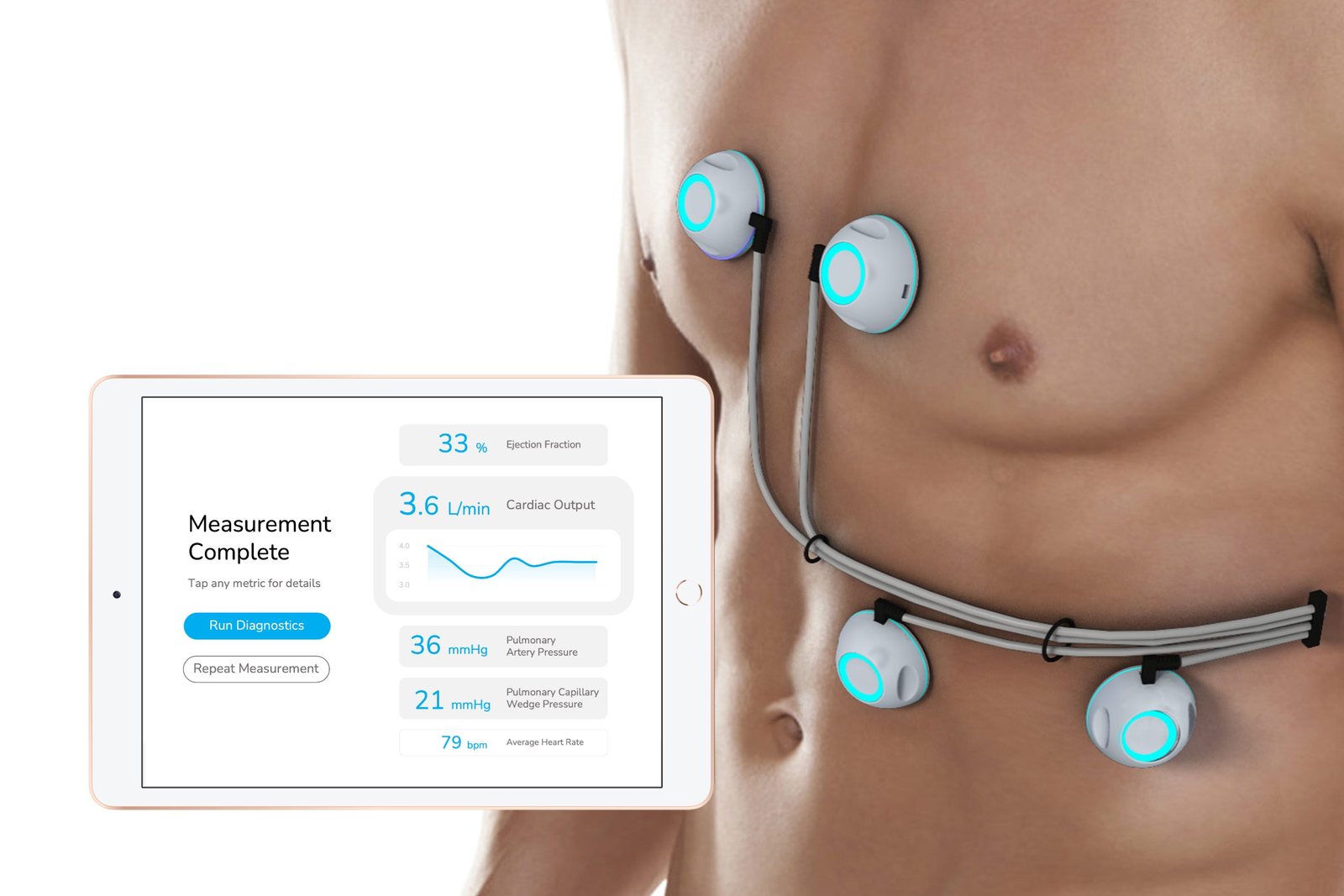
The Cardiac Performance System is a cart-based console paired with disposable, single-use sensors that attach to a patient's chest. Rather than threading a catheter into the pulmonary artery, CPS captures acoustic signals — the sounds and vibrations the heart and great vessels produce — alongside electrical signals, then applies AI algorithms trained against catheterization data to estimate ejection fraction, cardiac output and pulmonary artery pressure. FDA's 2018 clearance covers the ejection-fraction estimate; the 2022 Breakthrough Device designation covers the additional pressure and output measurements, which remain investigational pending the ACOUSTIC-1 results.
No needle, no catheter, no infusion suite
No catheter required
CPS is designed to estimate pulmonary artery pressure from the chest surface, avoiding the jugular or femoral catheter insertion that right-heart catheterization and implantable sensors both require.
Trained against the clinical gold standard
Colle Capital's Victoria Grace points to CPS's algorithms being developed against catheterization-derived data — the measurement CPS is designed to approximate without the procedure itself.
A billing code already exists
Grace also cites an existing CPT code for the measurement category as a reason the company expects a clearer reimbursement path than an entirely novel diagnostic would face.
The home-monitoring case CardioMEMS already made
Abbott's CardioMEMS HF System, an implantable pulmonary-artery pressure sensor, has already shown what pressure-guided heart-failure management is worth: the CHAMPION trial linked it to a 28% reduction in heart-failure hospitalizations at six months and 37% at fifteen months versus standard care, and a Medicare-focused analysis reported a 58% reduction in all-cause readmissions with roughly $10,500 in six-month cost savings per patient. CardioMEMS requires a one-time catheter-based implant; CPS, if its broader measurements win FDA authorization, would offer a non-invasive alternative that a clinic could use repeatedly without any procedure at all.
Where CardioMEMS proved the model
$1.5B → $3.7B
Non-invasive hemodynamic monitoring, two forecasts: Intent Market Research (2024 to 2030) and Coherent Market Insights (2026 to 2033).
Sources: Intent Market Research, Non-Invasive Hemodynamic Monitoring System Market Report. · Coherent Market Insights, Non-Invasive Hemodynamic Monitoring System Market Insight.
Regulatory News outlook
We expect the market to track nearer the steeper of the two published curves, since Medicare's own CardioMEMS cost data gives payers a concrete financial reason to fund earlier, more frequent pressure monitoring once a non-invasive alternative clears FDA.
How we got here: Coherent's 10.5% CAGR, held for four years from its $1.85 billion 2026 base, implies about $2.7 billion in 2030 non-invasive hemodynamic-monitoring spend: $1.85B × 1.105^4 ≈ $2.7B — faster growth than Intent's 5.2% CAGR because an invasive implant's cost and procedural risk cap how many heart-failure patients CardioMEMS alone can reach.
CPS against the ways doctors already measure pressure
| Method | Form | Measures | Setting | FDA status |
|---|---|---|---|---|
| Cardiac Performance System (Sensydia) | Non-invasive, chest-worn sensors | Ejection fraction, cardiac output, PA pressure | Office, clinic, hospital | EF cleared (2018); PA pressure in pivotal study |
| CardioMEMS HF System (Abbott) | Implanted sensor, catheter placement | Pulmonary artery pressure | Home, after one-time implant | FDA approved |
| Right heart catheterization | Invasive catheter procedure | Pulmonary artery pressure, cardiac output | Hospital or cath lab only | Established clinical standard, not an FDA-regulated product |
From each company's own labelling and announcements, and published clinical literature; not a clinical comparison.
The pivotal study this money is paying for
Sensydia's own account of the round is specific about what it buys: finishing ACOUSTIC-1, preparing for FDA authorization of CPS's pressure and output measurements, and getting ready to launch commercially once that happens. What it does not specify — enrollment numbers, a completion date, or whether FDA has indicated what evidence bar the pivotal data needs to clear — are the questions that will determine whether this $6 million is enough, or merely the next installment in a financing history that already includes an $8 million round in 2023 and NIH grant support.
- What's funded: completion of the ACOUSTIC-1 pivotal study, FDA authorization activities and commercial-launch preparation for CPS's broader hemodynamic measurements.
- What's already authorized: only the 2018-cleared ejection-fraction measurement; pulmonary artery pressure and cardiac output remain investigational under the 2022 Breakthrough Device designation.
- Lead investor reversal: Colle Capital Partners leads the 2026 round; Orlando Health Ventures led the 2023 round. Both have now backed Sensydia twice.
- Still undisclosed: ACOUSTIC-1's enrollment target, trial registry entry and expected completion date.
Sources & further reading
- Sensydia, “Sensydia Secures Oversubscribed Funding to Deliver Groundbreaking Cardiac Performance System to the Office, Hospital, and Clinic,” PR Newswire, 13 October 2026. prnewswire.com
- Pulse2, “Sensydia Raises More Than $6 Million To Advance Cardiac Performance System Toward FDA Authorization,” 13 October 2026. pulse2.com
- FinSmes, “Sensydia Raises $6M in Initial Closing of New Funding,” 13 October 2026. finsmes.com
- Sensydia, “Sensydia Receives FDA Breakthrough Device Designation for CPS Non-Invasive Cardiac Monitoring Device,” company post, January 2022. sensydia.com
- Sensydia, “Sensydia Appoints Anthony Arnold as President & CEO,” company post, 1 October 2019. sensydia.com
- National Center for Biotechnology Information, “CardioMEMS Heart Failure System: An Up-to-Date Review.” ncbi.nlm.nih.gov
- Intent Market Research, Non-Invasive Hemodynamic Monitoring System Market Report. intentmarketresearch.com
- Coherent Market Insights, Non-Invasive Hemodynamic Monitoring System Market Insight. coherentmarketinsights.com
Regulatory News reports on public regulatory documents. It is not legal advice, and the primary sources above govern. If we have made an error, we will say so in public: see corrections.
Frequently asked questions
What did Sensydia announce on 13 October 2026?
An oversubscribed initial closing of more than $6 million, led by Colle Capital Partners with Orlando Health Ventures participating, to complete the ACOUSTIC-1 pivotal study for its Cardiac Performance System (CPS) and to prepare for FDA authorization and commercial launch.
Has FDA cleared or authorized CPS?
Partly. FDA cleared CPS in 2018 for non-invasive measurement of ejection fraction, and granted it Breakthrough Device designation in 2022 for its broader hemodynamic measurements, including pulmonary artery pressure. Those broader measurements are not yet FDA-authorized; a pivotal study is required first.
What does the Cardiac Performance System measure?
CPS is a non-invasive, cart-based platform that uses disposable sensors to capture acoustic (heart sound) and electrical signals from the chest, then applies AI algorithms to estimate ejection fraction, cardiac output and pulmonary artery pressure without a catheter.
Is this Sensydia's first funding round?
No. Sensydia raised roughly $8 million in May 2023, led by Orlando Health Ventures with Colle Capital Partners participating, and has received National Institutes of Health grant funding. The October 2026 round reverses those lead roles, with Colle Capital leading.