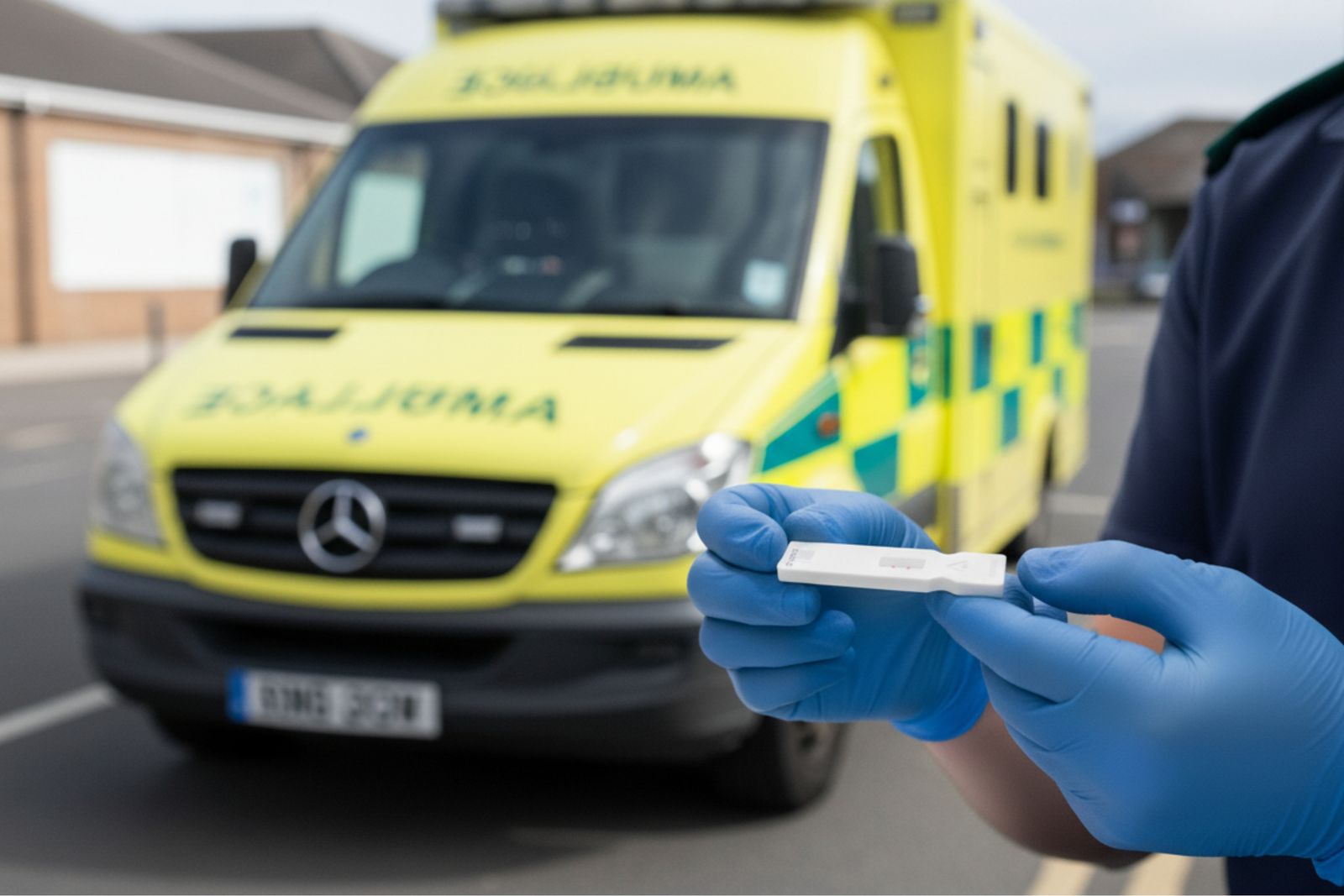
UpFront Diagnostics has won CE mark certification under the EU’s In Vitro Diagnostic Regulation for LVOne, a fingerstick blood test the Cambridge, UK company describes as the world’s first rapid blood test to diagnose stroke. Announced 16 September 2026, the mark lets UpFront sell LVOne commercially across the European Union, building on a UK launch earlier this year that is already running as a live paramedic pilot with London Ambulance Service.
What the CE mark covers
UpFront Diagnostics, incorporated in Cambridge in 2017 as Pockit Diagnostics Ltd, announced CE mark certification for LVOne under the EU’s In Vitro Diagnostic Regulation (IVDR) on 16 September 2026. The mark confirms the device meets EU safety and performance requirements and permits its commercial sale across the European Union — a broader market than the UKCA mark the company secured for LVOne around May 2026, which covers only the UK.
The company describes LVOne as the world’s first rapid blood test to diagnose stroke; independent trade coverage has framed the claim more narrowly, as the first test of its kind to reach CE mark certification specifically. We found no independent outlet that disputes the underlying claim, but none that verifies it beyond restating the company’s own framing, so we report it here as UpFront’s claim rather than an independently adjudicated first.
“[The approval] marks a major regulatory milestone that accelerates our mission to reduce diagnostic times.” Gonzalo Ladreda, Chief Executive, UpFront Diagnostics — 16 September 2026 announcement
Cambridge to the back of a London ambulance
Pockit to LVOne
- 2017
Founded in Cambridge as Pockit Diagnostics
- 2024
RADAR validation published
Diagnostic accuracy of the GFAP/D-dimer point-of-care test reported in Stroke: Vascular and Interventional Neurology.
- June 2025
Regulatory support funding
A MedTech Accelerator (MARRS) award through CPI to support the IVDR technical file.
- May 2026
UKCA mark and London Ambulance Service pilot
About 280 vehicles across north central London.
- 16 September 2026
CE mark under IVDR
Commercial sale across the European Union.
- Next six months
Pilot expands across north London
To north west and north east London, a combined population of about 6.5 million.
- Not yet dated
United States
The company has stated its intention to pursue U.S. clearance; no pathway or filing date disclosed.

LVOne in four numbers
Figures from the published RADAR validation and the 16 September 2026 announcement.
Two strips, a lancet and no instrument
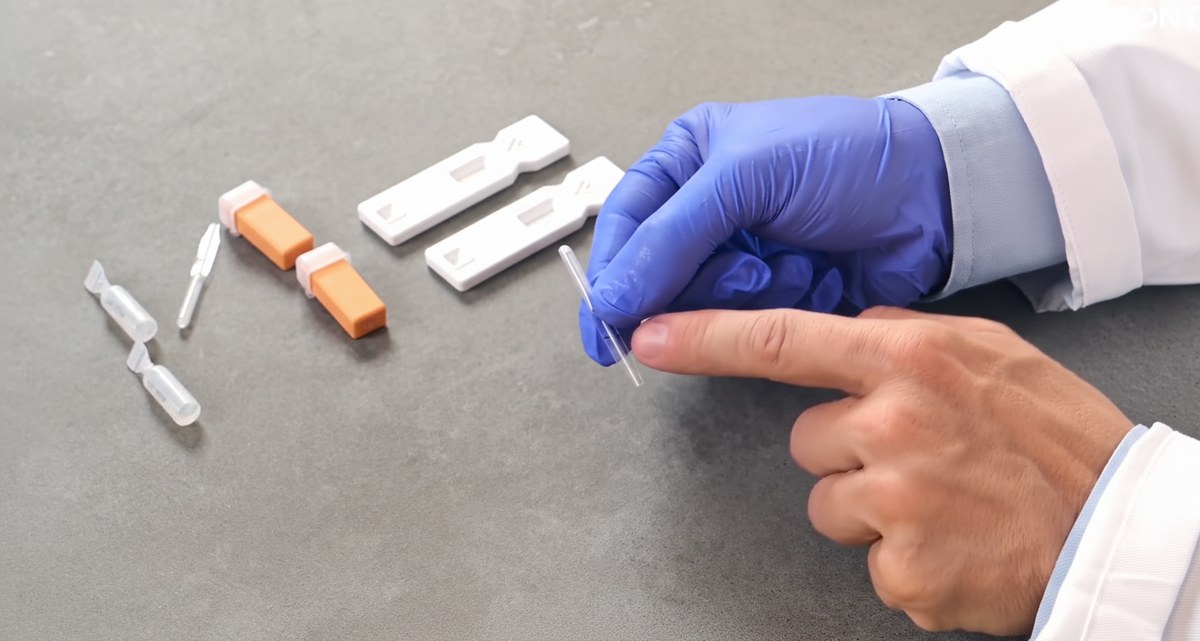
LVOne uses two lateral-flow immunoassay strips to measure glial fibrillary acidic protein (GFAP) and D-dimer from a capillary fingerstick sample. Both markers rise in ways that correlate with large-vessel-occlusion (LVO) ischemic stroke; the strips are read visually, without a separate cartridge reader, which is what makes the test usable in the back of a moving ambulance. UpFront worked with contract manufacturer Abingdon Health to scale production and manufacturing quality control for both strips.
In a 210-patient validation cohort published as part of the company’s RADAR study in the American Heart Association journal Stroke: Vascular and Interventional Neurology, LVOne showed 75% sensitivity and 92% specificity for LVO stroke, with a negative predictive value of 97%. The study’s authors caution that further work is needed to confirm diagnostic performance specifically in capillary blood collected during real-world emergency triage, rather than in the more controlled conditions of a validation study.
Why a blood test beats a bedside score
No instrument, no lab
Two lateral-flow strips read by eye from a fingerstick, which is what lets a paramedic run it in the back of a moving ambulance rather than a triage bay.
Biology, not a bedside score
Across 58 studies and 58,381 patients, prehospital stroke scales pool to 72% sensitivity and 77% specificity. LVOne’s validation reported 75% and 92%, with a 97% negative predictive value — a measurement, not an examination.
Already in the field
The London Ambulance Service pilot has run across about 280 vehicles since May 2026, with crews combining the strip result with existing assessments before deciding where to drive.
The decision hospital AI cannot reach
LVOne sits at the front of a stroke pathway that has been rebuilt around one number: minutes to thrombectomy. The money so far has gone to the hospital end — CT-based AI triage from Viz.ai, RapidAI and Brainomix that spots a large-vessel occlusion once a scan exists — and that market is forecast to grow fivefold by 2030. A prehospital blood test addresses the decision those tools cannot reach: which hospital to drive to. Its addressable pool is every suspected stroke an ambulance attends.
Stroke AI, the adjacent market
$0.32B → $1.60B
Stroke AI (imaging-based detection and triage) market, 2025 to 2030, as forecast by MarketsandMarkets (38.4% CAGR) — the hospital-side market LVOne complements from the ambulance.
Sources: MarketsandMarkets, Stroke AI Market Report 2025–2030 · Stroke Association, UK stroke statistics · European Stroke Organisation, Stroke Action Plan for Europe
Regulatory News outlook
We estimate a UK and EU opportunity of €30–50 million a year at full adoption on confirmed strokes alone, and two to three times that if the test is run on every suspected stroke an ambulance attends — before any U.S. clearance.
How we got here: Over 100,000 strokes a year in the UK (Stroke Association) plus 1.1 million a year in Europe (ESO) at an assumed €25–40 per test; suspected-stroke callouts run at two to three times confirmed strokes in published ambulance series. The price and the multiplier are our assumptions, not the company’s.
LVOne and the other ways to spot a large-vessel stroke
| Approach | What it measures | Where it is used | Evidence |
|---|---|---|---|
| LVOne (UpFront Diagnostics) | GFAP and D-dimer from a fingerstick, two visual lateral-flow strips | In the ambulance, before hospital; CE mark (IVDR) and UKCA | RADAR validation, n = 210: 75% sensitivity, 92% specificity, 97% NPV for LVO |
| Prehospital stroke scales (RACE, FAST-ED, LAMS) | A scored clinical examination | In the ambulance; free, in use worldwide | Meta-analysis of 58 studies: pooled 72% sensitivity, 77% specificity |
| CT-based AI triage (Viz.ai, RapidAI, Brainomix) | Automated reading of hospital CT angiography | After arrival at a hospital with a scanner; cleared and CE-marked | Detects LVO within minutes of a scan; cannot inform the routing decision before arrival |
| Mobile stroke units | A CT scanner and lab inside an ambulance | A handful of cities; high capital and staffing cost | Randomized trials show faster treatment where deployed |
From company announcements, published validation and review literature; not a head-to-head clinical comparison.
Every minute to thrombectomy
Mechanical thrombectomy for LVO stroke is only available at specialist centers, and every added minute between symptom onset and treatment costs brain tissue. Paramedics today largely rely on clinical stroke scales to decide whether to bypass the nearest hospital for a thrombectomy-capable one — scales that are fast but imperfect. A blood-based triage tool that can be read at the roadside, without waiting for a lab, targets exactly that decision point: whether a given patient’s stroke is large-vessel enough to justify the extra transport time to a Hyper Acute Stroke Unit.
UpFront chief executive Gonzalo Ladreda said the approval “marks a major regulatory milestone that accelerates our mission to reduce diagnostic times,” adding that “the LVOne test democratises access to early stroke diagnosis.” The company’s London Ambulance Service pilot, running since roughly May 2026 across about 280 vehicles in north central London, is the real-world test of that claim: paramedics there combine the fingerstick result with existing stroke-assessment tools before deciding where to route a patient.
An EU launch, north London, then America
- EU launch: UpFront says it will begin commercial sale of LVOne across the European Union now that the CE mark is in hand.
- UK pilot expansion: the London Ambulance Service pilot is intended to expand from north central London into north west and north east London over a six-month period, reaching a combined population the company estimates at 6.5 million.
- United States: UpFront has said it intends to pursue U.S. regulatory clearance, but has not disclosed a submission pathway, filing date, or timeline.
What is not yet public: the notified body that reviewed the IVDR technical file and the device’s specific risk classification, which UpFront has not published. We also note a discrepancy worth flagging for regulatory readers: marketing materials describe a result in under 10 minutes, while the published RADAR study protocol describes a turnaround closer to 15 minutes — we could not confirm which figure describes the CE-marked, commercial version of the assay.
Sources & further reading
- UpFront Diagnostics, “UpFront Diagnostics Announces CE Mark Approval for LVOne — the World’s First Rapid Blood Test to Diagnose Stroke,” press release, 16 September 2026. globenewswire.com
- “Upfront Diagnostics Debuts Rapid Blood Test for Identifying Stroke,” Medical Product Outsourcing, September 2026. mpo-mag.com
- RADAR study group, diagnostic-accuracy validation of a point-of-care GFAP/D-dimer assay for large-vessel-occlusion stroke, Stroke: Vascular and Interventional Neurology. pmc.ncbi.nlm.nih.gov
- UpFront Diagnostics, LVOne product page. upfrontdiagnostics.com
- “Upfront Dx Obtains UKCA Mark for Stroke Test,” 360Dx, 2026. 360dx.com
- UpFront Diagnostics, “UpFront Diagnostics Secures Funding to Support CE Mark Approval of LVOne,” June 2025. upfrontdiagnostics.com
- “Stroke Scales for Large Vessel Occlusion in the Prehospital Emergency Setting: A Systematic Review and Meta-Analysis” (58 studies, 58,381 patients), PMC. pmc.ncbi.nlm.nih.gov
- MarketsandMarkets, “Stroke AI Market Report 2025–2030.” marketsandmarkets.com
- Stroke Association, stroke statistics (over 100,000 strokes a year in the UK). stroke.org.uk
- European Stroke Organisation, Stroke Action Plan for Europe 2018–2030 (1.1 million strokes a year in Europe). eso-stroke.org
Regulatory News reports on public regulatory documents. It is not legal advice, and the primary sources above govern. If we have made an error, we will say so in public: see corrections.
Frequently asked questions
What does LVOne test for?
Large-vessel-occlusion (LVO) ischemic stroke. It measures two blood biomarkers, GFAP and D-dimer, from a fingerstick sample using two lateral-flow strips that a paramedic reads visually, without a separate reader instrument.
What did the CE mark cover, and when?
UpFront Diagnostics announced CE mark certification under the EU's In Vitro Diagnostic Regulation (IVDR) on 16 September 2026, permitting commercial sale of LVOne across the European Union. The company had previously obtained a UKCA mark for the UK market around May 2026.
How accurate is LVOne?
A peer-reviewed validation of the assay, published as part of the RADAR study in Stroke: Vascular and Interventional Neurology, reported 75% sensitivity and 92% specificity for detecting LVO stroke in a 210-patient cohort. The study's authors note further studies are needed to confirm performance in real-world paramedic use.
Is LVOne in use anywhere today?
Yes. Following its UK launch, London Ambulance Service began piloting LVOne on roughly 280 vehicles across north central London in May 2026, with a stated plan to expand to north west and north east London over a six-month pilot.