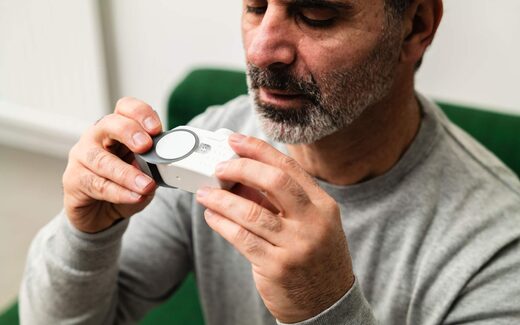

Ceribell, Inc. said 30 September 2026 that FDA cleared three new software features for its point-of-care EEG system: a trending tool meant to catch early signs of brain distress, a simplified long-term monitoring mode drawing on standard neonatal EEG practice, and a tool to help clinicians fine-tune sedation during severe seizures. The company says the clearance applies from premature infants through adults. As of this writing, that account rests entirely on Ceribell's own release — no independent trade-press coverage of this specific clearance has surfaced.
What the three features do
Ceribell's core product is a point-of-care EEG system — a disposable headband, a pocket recorder, and a cloud portal running the company's Clarity seizure-detection algorithm — built to flag suspected seizure activity at the bedside in an emergency department or intensive care unit without waiting for a conventional EEG or a neurologist's read. The three features cleared in this round layer onto that same hardware. Alpha-Delta Ratio and Relative Alpha Trending continuously compare EEG frequency bands to help clinicians spot early signs of reduced blood flow to the brain — Ceribell's release specifically cites aneurysmal subarachnoid hemorrhage as a target use case, where early detection of deteriorating brain activity can prompt faster intervention. Amplitude-Integrated EEG compresses raw EEG into a simplified long-term trend display, a format standard in neonatal intensive care, which Ceribell says it is now extending to complement adult ICU monitoring as well. Burst Suppression Monitoring gives a real-time read on brain activity that clinicians use to titrate sedation during severe, ongoing seizures or to manage brain swelling. “In critical care, time is brain, and every hour spent waiting for interpretation of EEG is time lost delivering treatment at the bedside,” Ceribell co-founder and CEO Jane Chao, PhD, said in the announcement. The company says the features will reach customers through an automatic software update in the first half of 2027 — it did not give a more specific date.
A fast-moving clearance record, and a thin paper trail on this one
Ceribell's core EEG device was first cleared in 2017, and the company has returned to FDA repeatedly since: electrographic status epilepticus detection in 2023, pediatric seizure detection in April 2025, neonatal seizure detection in November 2025, continuous delirium monitoring — the first FDA-cleared continuous EEG-based delirium screen — in December 2025, a Breakthrough Device Designation (not a clearance) for large-vessel-occlusion stroke detection in January 2026, and AI tools for epileptiform-abnormality detection on its cloud Neurology Portal in August 2026. Several of those — the neonatal and delirium clearances in particular — drew independent coverage from MedTech Dive, MassDevice, and MDDIOnline. This one, as of this writing, has not: every account Regulatory News found traces back to Ceribell's own 30 September release, syndicated across wire aggregators, plus the underlying exhibit the company filed with the Securities and Exchange Commission. Ceribell's release also does not cite a 510(k) number specific to these three features, and FDA's public device-classification records show several 2026 Ceribell submissions decided months earlier, in the spring, that appear tied to other, already-announced clearances rather than this one. A 510(k) clearance is a substantial-equivalence finding, not an independent assessment of clinical benefit; RA and clinical teams evaluating these features on their own merits should treat Ceribell's description of them, for now, as the company's own characterization rather than an independently verified one.
Frequently asked questions
What did FDA clear?
Three new software features on the Ceribell System: Alpha-Delta Ratio/Relative Alpha Trending, Amplitude-Integrated EEG, and Burst Suppression Monitoring, per Ceribell's 30 September 2026 announcement.
Is this Ceribell's first EEG clearance?
No. Its core system was first cleared in 2017, with additional clearances in 2023, 2025, and earlier in 2026 — this is roughly its fourth or fifth distinct software clearance in under a year.
Who can be monitored with the new features?
Ceribell says there is no age restriction, covering premature newborns through adults — the company's own characterization, consistent with language used for prior clearances but not independently verified here.
When will the features ship, and is a 510(k) number public?
Ceribell says rollout comes via automatic software update in the first half of 2027. No specific 510(k) number was cited in its announcement or confirmed elsewhere.
Sources & further reading
- Ceribell, Inc., Exhibit 99.1 to Form 8-K, “Ceribell Receives FDA 510(k) Clearance for Quantitative EEG Trending and Amplitude-Integrated EEG Analysis,” filed with the U.S. Securities and Exchange Commission, 30 September 2026. sec.gov
- The same release as syndicated on GlobeNewswire. globenewswire.com
- MedTech Dive, “Ceribell wins FDA clearance for seizure detection in neonates” — independent coverage of the company's November 2025 clearance, for background on its clearance history. medtechdive.com
- MassDevice, “Ceribell gets FDA nod for delirium monitoring” — independent coverage of the company's December 2025 clearance, for background. massdevice.com
Regulatory News reports on public regulatory documents. It is not legal advice, and the primary sources above govern. If we have made an error, we will say so in public: see corrections.