

EBR Systems has won a Medicare payment increase of as much as 93 percent for its WiSE CRT System, after the Centers for Medicare & Medicaid Services finalized a reclassification that moves the leadless heart-pacing device into a higher-paying diagnosis-related group. The Sunnyvale, California company announced the decision on 21 September 2026; it takes effect 1 October 2026, the first day of Medicare's 2027 fiscal year.
WiSE's reimbursement reset, in four figures
Figures from EBR Systems’ 21 September 2026 ASX announcement and its Q2 CY2026 quarterly report.
The category WiSE just got priced into
Cardiac resynchronization therapy is a mature device category dominated by three companies: Medtronic, Abbott and Boston Scientific together account for roughly 92.4% of the CRT market, according to a Bell Potter research note. EBR Systems is not trying to take share from that trio's existing CRT-D and CRT-P base directly — the WiSE CRT System is positioned for patients a standard device cannot reach: those whose coronary-sinus left-ventricular lead failed, dislodged or was never placeable, and those for whom a lead upgrade carries high surgical risk.
What the CRT category is worth
$6.96B → $9.72B
Global cardiac resynchronization therapy (CRT) device market, 2025 to 2034, as forecast by Fortune Business Insights.
Sources: Fortune Business Insights, Cardiac Resynchronization Therapy (CRT) Devices Market report · Bell Potter, EBR Systems research note (CRT market share by manufacturer)
Regulatory News outlook
We expect WiSE's new DRG classification, alongside CMS's parallel national coverage review, to expand the CRT category's addressable pool by reaching lead-failure and high-risk-upgrade patients standard CRT devices do not serve today, rather than taking share from the incumbents' existing base.
How we got here: Fortune Business Insights' published 3.7% compound annual growth rate on its $6.96 billion 2025 estimate reaches roughly $9.72 billion by 2034; we treat WiSE's volume as additive to, not substitutional for, that figure, since EBR's own patient population is defined by standard-CRT failure or ineligibility rather than head-to-head competition for new CRT candidates.
WiSE against the CRT category it enters
| Product | LV lead type | Target patients | US status | Medicare DRG |
|---|---|---|---|---|
| WiSE CRT System (EBR Systems) | Leadless, ultrasound-paced endocardial electrode | Lead-placement failures, high-risk CRT upgrades | FDA PMA approved, Apr 2025 | MS-DRG 228/229 (new, Oct 2026) |
| Standard CRT-D / CRT-P (Medtronic, Abbott, Boston Scientific) | Coronary-sinus lead to the left ventricle | Conventional CRT candidates | FDA approved (established devices) | MS-DRG 242/243/244 (standard pacemaker) |
| Micra / Aveir leadless pacemakers (Medtronic, Abbott) | Not applicable — single/dual-chamber RV pacing only | Bradycardia, not CRT | FDA approved (established devices) | MS-DRG 228/229 (leadless pacemaker category) |
From each company’s own labelling, FDA records and CMS rulemaking; not a clinical comparison. Micra and Aveir are leadless-pacing category peers, not CRT competitors.
Pacing the left ventricle without a lead
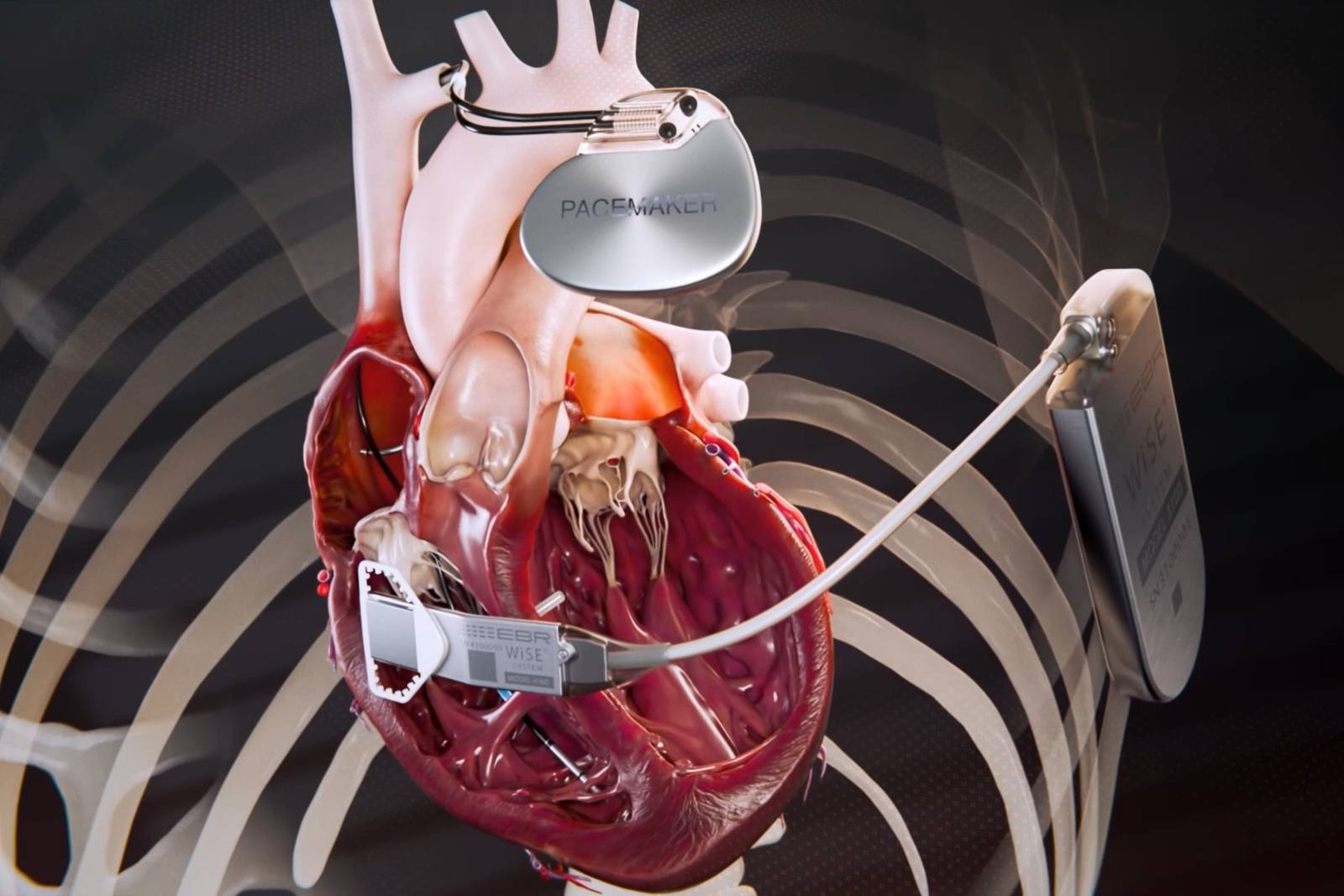
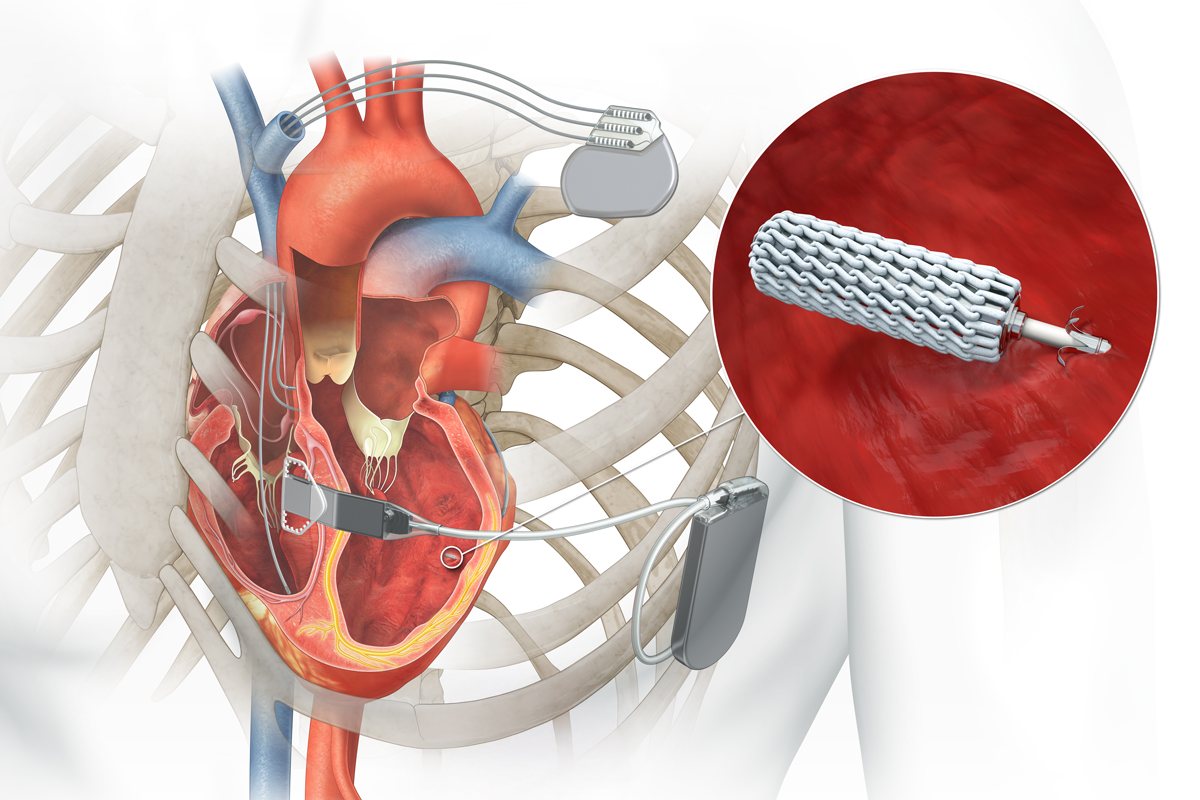
Standard cardiac resynchronization therapy paces the heart's left ventricle through a lead threaded into the coronary sinus, a vein on the heart's surface — a lead that can fail to place, dislodge or become infected in a meaningful minority of patients. The WiSE CRT System replaces only that left-ventricular lead: a tiny endocardial electrode, implanted inside the left ventricle itself, receives its pacing pulse wirelessly from a small ultrasound transmitter placed under the skin, working alongside the patient's existing right-ventricular pacemaker or defibrillator rather than replacing it.
Three things WiSE changes for a CRT program
No lead in the LV
The left-ventricular electrode sits inside the heart with no lead running through the coronary sinus, removing the failure point — dislodgement, phrenic-nerve stimulation, non-placement — that keeps some patients off standard CRT entirely.
Built for standard-CRT failures
EBR Systems positions WiSE for patients whose coronary-sinus lead could not be placed or failed, and for high-risk lead upgrades — a population the device's own FDA approval and CMS reimbursement are both scoped around.
Paid as leadless now
The FY2027 DRG reclassification moves WiSE out of the standard-pacemaker payment bucket and into the leadless-pacemaker category CMS already uses for devices like Medtronic's Micra, formally recognizing the resources a leadless LV implant requires.
What changes for hospitals on October 1
The FY2027 IPPS final rule reassigns eligible WiSE procedures from MS-DRG 242 and 244 — the standard "Permanent Cardiac Pacemaker Implant" categories — to MS-DRG 228 and 229, the leadless-pacemaker categories, raising base Medicare inpatient payment by roughly 58% and 93% respectively. New Technology Add-on Payment support, first granted at its maximum rate from 1 October 2025 against a roughly $63,300 average WiSE selling price, continues to stack on top of the new, higher base rate.
“The final FY2027 Medicare payment rates represent a significant reimbursement and commercial milestone for WiSE. The increased inpatient reimbursement provides hospitals with a clearer and stronger payment pathway for eligible WiSE procedures, while better recognising the resources required to deliver this differentiated leadless technology.” John McCutcheon, President and Chief Executive Officer, EBR Systems — 21 September 2026 announcement
From a 2003 Sunnyvale startup to a DRG change
WiSE's road to Medicare's leadless category
- 2003
EBR Systems founded
Founded in Sunnyvale, California, by Richard E. Riley and Debra Sheryl Echt.
- November 2021
ASX listing
Initial public offering on the Australian Securities Exchange, raising roughly A$108.1 million.
- May 2023
SOLVE-CRT trial halted for success
The pivotal trial met its efficacy and safety endpoints early at interim analysis, triggering an early halt.
- 11 April 2025
FDA premarket approval
FDA approves the WiSE CRT System, the first leadless left-ventricular endocardial pacing system for cardiac resynchronization therapy.
- 1 October 2025
NTAP and TPT reimbursement begin
New Technology Add-on Payment and Transitional Pass-Through reimbursement take effect at the maximum rate; limited market release begins.
- 3 June 2026
CMS opens national coverage review
Via the TCET pathway, CMS formally initiates a National Coverage Determination review for WiSE — a separate process from the DRG payment change below.
- 21 September 2026
FY2027 DRG reclassification finalized
CMS finalizes the move to MS-DRG 228/229, raising base Medicare payment by roughly 58% and 93%, effective 1 October 2026.
- 3 March 2027
Final coverage decision due
CMS's National Coverage Determination for WiSE, via the TCET pathway, is projected to conclude.
What this reimbursement decision does not resolve: CMS's separate national coverage review of WiSE remains open, with a final decision not due until March 2027, so the device's longer-term Medicare coverage status — as distinct from this payment-rate change within existing coverage — is still being determined. EBR Systems' own disclosures do not break out WiSE revenue from total company revenue in a way that lets an outside reader isolate the device's commercial trajectory independent of the company's broader financials.
- Payment change: MS-DRG 242→228 (+58%) and MS-DRG 244→229 (+93%), effective 1 October 2026, with continued NTAP support.
- Separate process: CMS's TCET-pathway National Coverage Determination review for WiSE remains open, final decision projected 3 March 2027.
- Commercial base: 117 cumulative commercial implants through the quarter ended 30 June 2026, including master purchasing agreements with HCA Healthcare, Advocate Health and CHRISTUS Health.
- Not yet public: a WiSE-specific revenue breakout, and the official CMS rule text's exact wording for the new DRG titles, which this article has not independently confirmed against the primary rule document.
Sources & further reading
- EBR Systems, ASX announcement on CMS FY2027 IPPS reimbursement for the WiSE CRT System, 21 September 2026. announcements.asx.com.au
- StockWireX, “EBR Systems Wins Medicare Pay Rise of Up to 93% for Its WiSE Heart Device,” September 2026. stockwirex.com
- American College of Cardiology, “CMS Releases 2027 IPPS Final Rule,” 5 August 2026. acc.org
- Heart Rhythm Society, comments on the CMS FY2027 IPPS proposed rule. hrsonline.org
- MassDevice, coverage of FDA's premarket approval of the WiSE CRT System, April 2025. massdevice.com
- MarketIndex.com.au, “WiSE Accepted Into New TCET Reimbursement Pathway of CMS,” 2026. marketindex.com.au
- Bell Potter, EBR Systems research note (CRT market sizing and competitor share). bellpotter.com.au
Regulatory News reports on public regulatory documents. It is not legal advice, and the primary sources above govern. If we have made an error, we will say so in public: see corrections.
Frequently asked questions
What did CMS actually change for EBR Systems?
Under the FY2027 Inpatient Prospective Payment System final rule, CMS reassigned eligible WiSE CRT System procedures from the standard-pacemaker MS-DRGs (242/244) to the leadless-pacemaker MS-DRGs (228/229), raising base Medicare inpatient payment by roughly 58% and 93% respectively, effective 1 October 2026. It also continued New Technology Add-on Payment (NTAP) support.
Is this a new FDA approval?
No. FDA approved the WiSE CRT System under a premarket approval (PMA) on 11 April 2025. This is a Medicare payment decision, not a new regulatory clearance of the device itself.
Is this the same as CMS's national coverage review?
No, and the two are easy to conflate. CMS initiated a separate National Coverage Determination (NCD) review for WiSE via the TCET pathway on 3 June 2026, with a final decision projected for 3 March 2027. The 21 September 2026 news is a payment-rate change within WiSE's existing coverage, not that NCD outcome.
Who is WiSE intended for?
EBR Systems positions WiSE for heart-failure patients for whom a standard CRT device's coronary-sinus left-ventricular lead failed, could not be placed, or carries high risk to implant or upgrade — not as a general replacement for conventional CRT-D or CRT-P systems.