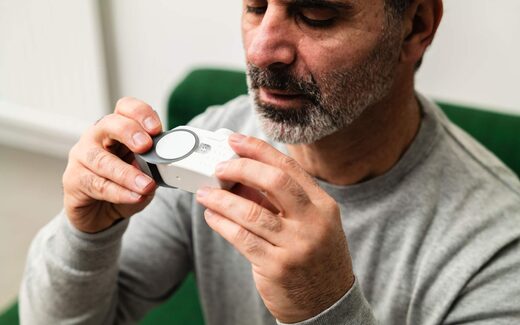

A robot can now legally draw your blood without a person's hands on the needle. On 19 August 2026, FDA granted a De Novo marketing authorization to Vitestro's Aletta, the first standalone device authorized to perform a full venous blood draw — vein-finding, needle insertion, tube collection and bandaging — on an adult outpatient without direct hands-on operation. The authorization does more than clear one device: it creates a new regulatory category, with special controls, that other robotic phlebotomy systems will now be measured against.
What FDA actually authorized
The De Novo pathway exists for novel, low-to-moderate-risk devices that have no existing predicate to be measured against — the manufacturer cannot use the ordinary 510(k) route because nothing like the device is already on the market. Granting a De Novo request does two things at once: it authorizes the specific device, and it creates a new regulatory classification, complete with special controls, that becomes the predicate future devices of that type can cite. FDA's authorization for Aletta does both. Vitestro can now market the device, and the special controls FDA wrote alongside the authorization — covering labeling, performance testing and clinical testing — become the standard the next robotic phlebotomy device has to meet, very likely through a faster 510(k) submission rather than another ground-up De Novo review.
How the device works, and where a human still has to be
Aletta uses near-infrared light together with Doppler ultrasound to locate a suitable vein in the patient's arm and to tell it apart from nearby arteries — the step where an unsupervised device would carry real risk if it got it wrong. Once a vein is selected, the system applies a tourniquet, prepares the skin, inserts the needle, collects into tubes, disposes of the needle, and applies a bandage. FDA's authorization is not for unattended use: the device must run under the oversight of a supervisor trained in phlebotomy, though that supervisor can watch up to three units at once, which is the ratio Vitestro and FDA are betting will make a dent in a chronic phlebotomist shortage rather than simply moving the same headcount around. Onboard sensors are built to catch trouble before it becomes an incident — if a patient moves excessively mid-draw, the needle automatically detaches and the procedure stops, and other sensors can pause the draw and alert the supervisor when they detect other unsafe conditions.
The clinical case, in the numbers that matter
- Overall first-stick success: 94.5% when a suitable vein was identified — the headline number FDA and Vitestro both cite.
- Higher BMI: 97.4% success in patients with a BMI above 30, a population where manual venipuncture can be harder, not easier.
- Self-reported difficult venous access: 92.7% — the hardest patient population in the dataset, and the one most likely to shape post-market scrutiny.
- Patients over 65: 93.4%, addressing a population disproportionately represented in routine outpatient blood work.
FDA's framing leaned on capacity, not novelty for its own sake. “Blood draws are one of the most commonly performed medical procedures in the United States, yet patients may face delays due to a growing shortage of trained phlebotomists,” said Michelle Tarver, M.D., Ph.D., director of FDA's Center for Devices and Radiological Health, in the agency's announcement. “This authorization reflects the FDA's commitment to advancing innovative medical devices that help meet a critical public health need while maintaining the safety and effectiveness patients deserve.” Vitestro, a Netherlands-based company, raised $70 million in a Series B round earlier in 2026 to fund commercialization and has targeted a 2027 U.S. commercial launch; outpatient labs and blood-draw centers are the expected first customers.
What this sets up for the next device
The practical significance for the device industry sits in the special controls, not the press release. A De Novo grant is a one-time, harder review; the special controls it produces are what let a competitor's robotic phlebotomy device reach the market through 510(k) substantial-equivalence review instead of repeating Aletta's path from scratch. Expect labs and staffing-model questions — the 1-to-3 supervision ratio, in particular — to be where competing devices differentiate first, since the clinical performance bar Aletta cleared is now the one every successor has to match or beat.
Frequently asked questions
What did FDA authorize on 19 August 2026?
Marketing authorization, through the De Novo pathway, for Vitestro's Aletta — the first standalone robotic device authorized to draw blood from a patient's arm without hands-on operator intervention. It is authorized for use in adults in outpatient settings.
How does Aletta work?
It uses near-infrared light and Doppler ultrasound to locate a suitable vein and distinguish it from arteries, then applies a tourniquet, prepares the skin, inserts and later disposes of the needle, changes collection tubes, and applies a bandage.
Does a person still need to be involved?
Yes. The device must operate under the oversight of a supervisor trained in phlebotomy, though one supervisor can oversee up to three Aletta units running at the same time. If a patient moves excessively during the draw, the needle automatically detaches and the procedure stops.
What clinical data supported the authorization?
FDA cited an overall first-stick success rate of 94.5% when a suitable vein was identified, with success holding up across harder cases: 97.4% in patients with a BMI above 30, 92.7% in patients with self-reported difficult venous access, and 93.4% in patients over 65.
Sources & further reading
- FDA, “FDA Authorizes First-Of-Its-Kind Robotic Blood Draw Device,” press announcement, 19 August 2026. fda.gov
- Vitestro, “FDA Authorizes First-of-Its-Kind Robotic Blood Draw Device,” press release, 19 August 2026. globenewswire.com
- “FDA De Novo For Aletta Creates New Regulatory Category For Robotic Phlebotomy,” Medtech Insight / Citeline. insights.citeline.com
- “FDA Authorizes Aletta Robotic Blood Draw Device for Outpatient Use,” Clinical Lab Products. clpmag.com
Regulatory News reports on public regulatory documents. It is not legal advice, and the primary sources above govern. If we have made an error, we will say so in public: see corrections.