

QIAGEN has won FDA 510(k) clearance for a one-hour PCR panel that identifies gram-negative bacteria and their resistance genes directly from a positive blood culture — the second half of a bloodstream-infection test menu the Venlo, Netherlands-based diagnostics company set out to build on its QIAstat-Dx platform. The clearance, announced 28 September 2026, pairs with an FDA clearance for the gram-positive and fungal half of the same menu seven weeks earlier, giving US labs 33 pathogen targets and 28 antimicrobial-resistance markers on one instrument.
One hour from a positive blood culture
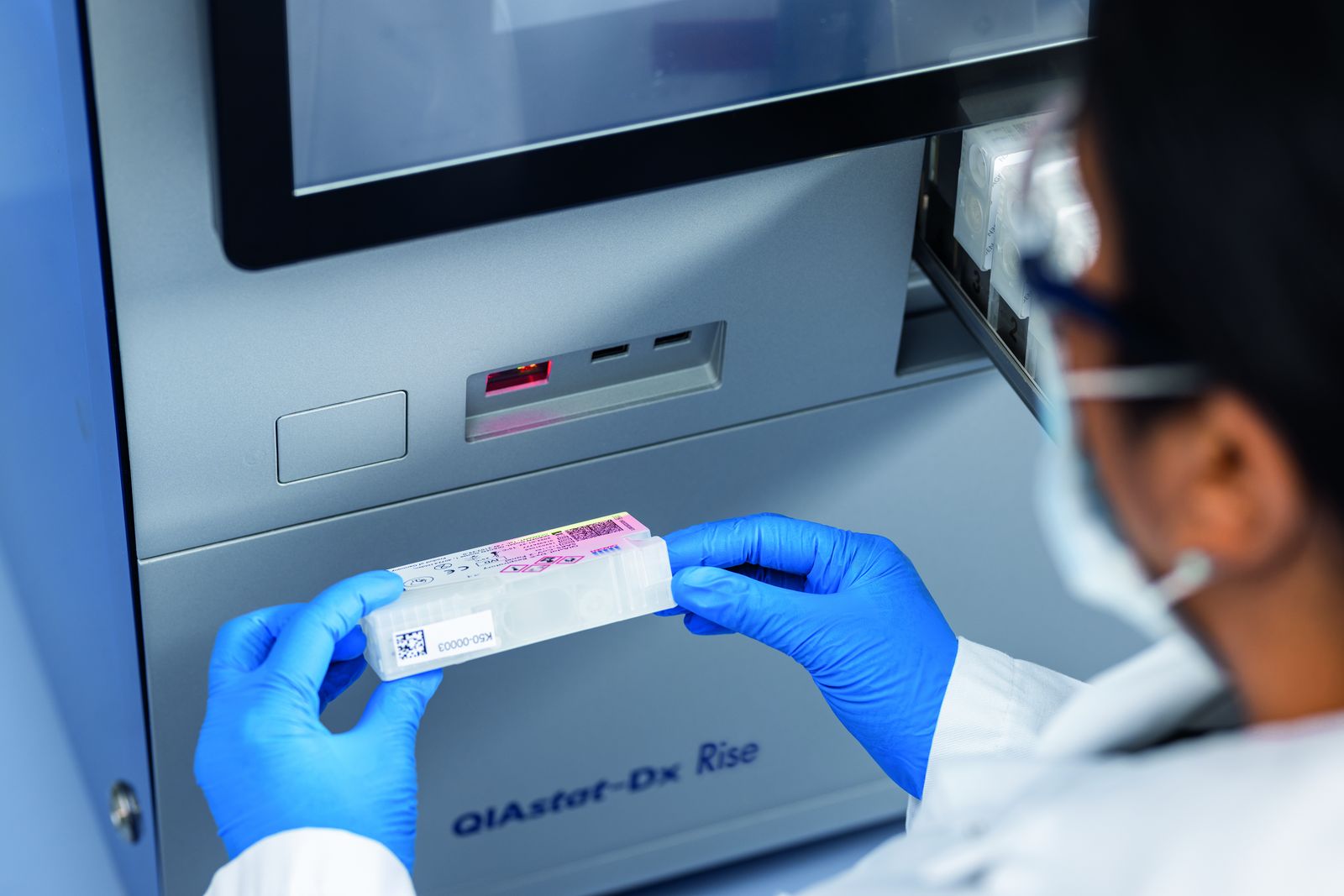
QIAGEN’s QIAstat-Dx is a syndromic PCR platform: a single cartridge runs dozens of targets at once from one sample, rather than a lab ordering tests one pathogen at a time. The new BCID GN Plus AMR Panel loads a positive blood culture directly into that cartridge and returns, in about an hour, a readout of 13 gram-negative bacterial targets — organisms such as E. coli, Klebsiella and Pseudomonas species that are common and dangerous causes of sepsis — alongside 18 genetic markers associated with antimicrobial resistance.
That combination matters because bloodstream infections are typically treated with broad-spectrum antibiotics the moment a blood culture turns positive, before a lab can say which organism is responsible or whether it resists the drug being used. Conventional culture-based identification and susceptibility testing can take one to three additional days. A genetic resistance marker is a predictor, not the final phenotypic susceptibility result a lab will still confirm — but an hour-long readout lets a clinician narrow or adjust therapy far sooner than culture allows.
Three things the panel pair changes
One hour, not days
Both panels return pathogen identification and resistance markers in about an hour from a positive blood culture, against the one-to-three-day turnaround of conventional culture-based identification and susceptibility testing.
Resistance markers included
The 18 AMR markers on the new panel ride alongside pathogen identification in the same hour-long run, rather than waiting on a separate susceptibility test ordered afterward.
A fourth menu, same box
Bloodstream infection is QIAstat-Dx’s fourth infectious-disease menu after respiratory, gastrointestinal and meningitis/encephalitis panels — a lab that already owns the instrument adds sepsis testing without buying new hardware.
The sepsis menu in four numbers
Figures from QIAGEN’s 10 August and 28 September 2026 FDA-clearance announcements.
Two panels, 33 targets, one platform
QIAGEN built toward this moment in stages. The BCID GPF Plus AMR Panel — covering gram-positive bacteria and fungi, 20 targets plus a broad gram-negative screening flag and 10 AMR markers — launched in Europe under CE-IVDR in April 2026 and cleared FDA on 10 August 2026, QIAGEN’s first US bloodstream-infection panel. The gram-negative companion followed the same path: a July 2026 European launch, then the 28 September US clearance. Nitin Sood, QIAGEN’s Senior Vice President and Head of Product Portfolio & Innovation, said of the pairing: “Bloodstream infections demand fast answers. With both panels now cleared in the U.S., laboratories can identify a broad range of pathogens and antibiotic resistance markers on the same QIAstat-Dx system.”
“Bloodstream infections demand fast answers. With both panels now cleared in the U.S., laboratories can identify a broad range of pathogens and antibiotic resistance markers on the same QIAstat-Dx system.” Nitin Sood, Senior Vice President and Head of Product Portfolio & Innovation, QIAGEN — 28 September 2026 announcement
Sepsis testing’s path to $2.4 billion
Sepsis diagnostics is a crowded, fast-moving corner of molecular testing, and published forecasts for it disagree sharply depending on how narrowly a research firm draws the category. QIAGEN enters it already running a large installed base: more than 5,200 QIAstat-Dx instruments placed worldwide through the end of 2025, across more than 100 countries, on a platform that already sells respiratory, gastrointestinal and meningitis/encephalitis panels into many of the same labs.
What a sepsis-diagnostics menu is worth
$1.10B → $2.40B
Global sepsis diagnostics market, 2026 to 2034, as forecast by Fortune Business Insights; MarketsandMarkets’ narrower definition of the same category puts 2029 at just $890 million.
Sources: Fortune Business Insights, Sepsis Diagnostics Market · MarketsandMarkets, Sepsis Diagnostics Market — Global Forecast to 2029
Regulatory News outlook
We expect rapid, AMR-inclusive bloodstream-infection panels to keep outgrowing the broader sepsis-diagnostics category as hospitals shift away from multi-day culture-based testing, pushing this narrower segment toward the high end of published forecasts by the early 2030s.
How we got here: Fortune Business Insights’ published 10.2% compound annual growth rate, applied to its 2026 estimate of $1.10 billion, reaches roughly $2.4 billion by 2034; we treat that trajectory as more likely than MarketsandMarkets’ narrower, more conservative $890 million 2029 estimate, given how quickly one-hour panels are displacing multi-day culture workflows in the hospitals QIAGEN already serves.
QIAGEN’s panels against rapid bloodstream-infection tests
| Product | Turnaround | Targets | AMR markers | Sample |
|---|---|---|---|---|
| QIAstat-Dx BCID GN+GPF (QIAGEN) | ~1 hour | 33 pathogens | 28 genetic markers | Positive blood culture |
| FilmArray BCID2 (bioMérieux) | ~1 hour | 33 bacteria and yeasts | 10 genetic markers | Positive blood culture |
| T2Bacteria Panel (T2 Biosystems) | ~3–5 hours | 5 ESKAPE species | Not applicable | Whole blood, no culture wait |
| Pheno system (Accelerate Diagnostics) | ~1.5–90 min ID; ~6.5–7 hr AST | Broad ID panel | Phenotypic susceptibility, not genetic markers | Positive blood culture |
From each company’s own labelling and announcements; not a clinical comparison.
From Düsseldorf chemists to Barcelona’s PCR lab
QIAGEN’s road to a sepsis menu
- 1984
QIAGEN founded
Founded in Düsseldorf, Germany, by scientists from Heinrich Heine University; its first product, a plasmid DNA purification kit, launched in 1986.
- 1996–1997
Public listings
IPO on Nasdaq in 1996, the first German company to list there, followed by a Frankfurt Stock Exchange listing in 1997.
- 2007
Digene acquisition
Acquired Digene Corporation for roughly $1.6 billion, expanding into molecular women’s-health testing.
- 2018
STAT-Dx acquisition
Acquired Barcelona-based STAT-Dx, whose syndromic multiplex-PCR platform became QIAstat-Dx.
- April & July 2026
European launches
The BCID GPF Plus AMR Panel and BCID GN Plus AMR Panel launch under CE-IVDR, completing the European bloodstream-infection menu first.
- 10 August 2026
First US clearance
FDA clears the BCID GPF Plus AMR Panel (K254194), QIAGEN’s first US bloodstream-infection panel.
- 28 September 2026
Second US clearance
FDA clears the BCID GN Plus AMR Panel, completing the US menu at 33 targets and 28 AMR markers.
- Ahead
510(k) indexing
FDA’s public 510(k) database has not yet posted a K-number for the new panel; we will update this page when it appears.
What’s left before the K-number clears
What this clearance does not yet establish: FDA’s 510(k) database had not posted a K-number specifically for the BCID GN Plus AMR Panel as of this writing, so the device’s formal clearance record is not yet independently checkable the way the August panel’s K254194 is. QIAGEN’s own announcement does not break out a separate revenue or installed-base figure for QIAstat-Dx bloodstream-infection testing specifically, so it is not possible to say from the public record how quickly hospitals are adopting the new menu.
- K-number: not yet indexed for the BCID GN Plus AMR Panel; we will update this page when FDA’s database posts one.
- Combined menu: 33 pathogen targets and 28 antimicrobial-resistance markers across both US-cleared panels, from a single positive blood culture.
- Installed base: more than 5,200 QIAstat-Dx instruments placed worldwide through the end of 2025, across more than 100 countries.
- Platform reach: bloodstream infection is QIAstat-Dx’s fourth infectious-disease menu, after respiratory, gastrointestinal and meningitis/encephalitis panels.
For regulatory and lab-operations readers, the sequencing is the instructive part: QIAGEN launched both panels in Europe first, where IVDR clearance came faster, and let the US clearances follow by months — a pattern increasingly common for diagnostics makers navigating slower FDA review timelines alongside IVDR’s own, differently paced requirements.
Sources & further reading
- QIAGEN, “QIAGEN Completes U.S. QIAstat-Dx Bloodstream Infection Portfolio With FDA Clearance of New Bacteria Detection Panel,” press release via Businesswire, 28 September 2026. businesswire.com
- GenomeWeb, “Qiagen Wins FDA Clearance for Gram-Negative Bloodstream Infection Panel,” 28 September 2026. genomeweb.com
- CLP Magazine, “FDA Clears QIAGEN QIAstat-Dx Gram-Negative BCID/AMR Panel,” 2026. clpmag.com
- QIAGEN, “QIAGEN Receives U.S. FDA Clearance for First QIAstat-Dx Bloodstream Infection Panel,” corporate newsroom, 10 August 2026. corporate.qiagen.com
- LabMedica, “One-Hour Molecular Panel Expands Bloodstream Infection Testing for Gram-Negative Pathogens,” 2026. labmedica.com
- U.S. FDA, 510(k) summary K254194 (QIAstat-Dx BCID GPF Plus AMR Panel). accessdata.fda.gov
- Fortune Business Insights, Sepsis Diagnostics Market report. fortunebusinessinsights.com
- MarketsandMarkets, “Sepsis Diagnostics Market is Expected to Reach $890 million,” via GlobeNewswire, 24 April 2024. globenewswire.com
- bioMérieux, BioFire Blood Culture Identification 2 (BCID2) Panel, product page. biomerieux.com
Regulatory News reports on public regulatory documents. It is not legal advice, and the primary sources above govern. If we have made an error, we will say so in public: see corrections.
Frequently asked questions
What did FDA clear for QIAGEN?
The QIAstat-Dx BCID GN Plus AMR Panel, a one-hour PCR panel run from a positive blood culture that detects 13 gram-negative bacterial pathogen targets and 18 antimicrobial-resistance markers. FDA cleared it on 28 September 2026.
Why does QIAGEN call this a completed portfolio?
FDA cleared the companion QIAstat-Dx BCID GPF Plus AMR Panel (gram-positive bacteria and fungi) on 10 August 2026. Together, the two panels cover 33 pathogen targets and 28 resistance markers on the same instrument.
Is there a 510(k) number for the new panel?
FDA's public 510(k) database had not indexed a number for the GN Plus AMR Panel as of this writing. The companion GPF Plus AMR Panel cleared in August under K254194.
How is this different from blood-culture-based susceptibility testing?
Conventional culture-based identification and susceptibility testing typically takes one to three days after a positive blood culture. QIAGEN's panels return pathogen identification and resistance markers in about an hour from the same positive culture, though AMR markers are genetic predictors, not a full phenotypic susceptibility result.