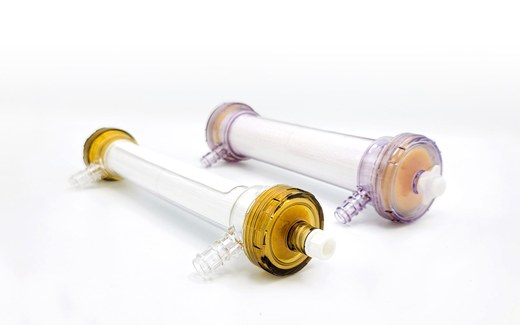


TELA Bio has won FDA 510(k) clearance for Liora Monofilament Scaffold, a fully resorbable synthetic mesh for soft tissue reinforcement — the first product the Malvern, Pennsylvania company has designed and manufactured entirely in its own cleanroom. The commercial-stage medtech company announced the clearance on 5 October 2026, adding a synthetic alternative to a portfolio built until now on biologic scaffolds derived from ovine rumen.
Liora in four numbers
Figures from the 5 October 2026 announcement and TELA Bio's public filings.
The first mesh made in Malvern
TELA Bio's existing portfolio — OviTex and OviTex PRS — pairs ovine (sheep) rumen-derived extracellular matrix with polymer fibers, a biocomposite approach the company has sold since its 2012 founding. Liora breaks from that design: according to the company's announcement, it is a fully resorbable synthetic monofilament scaffold with no biologic component, designed and produced entirely by TELA Bio's own engineers in its ISO-8 certified cleanroom.
“This is a significant milestone for TELA Bio as Liora is the first fully resorbable synthetic product in our portfolio to be designed and produced in-house by our team of innovative engineers. The addition of Liora to our portfolio expands the options available to surgeons and patients for their soft tissue reconstruction needs.” Heather Getz, CEO, TELA Bio — 5 October 2026 announcement
A fourth name in resorbable mesh
Fully resorbable synthetic mesh is a small, established category: GORE BIO-A Tissue Reinforcement (W.L. Gore), Phasix Mesh (BD) and TIGR Matrix Surgical Mesh (Novus Scientific) are the three products most often named in it, each built on a different polymer chemistry and resorption timeline. Liora gives TELA Bio its own entry, manufactured rather than sourced, in a field where the company previously competed only with its biologic OviTex line.
What sets Liora apart
Built in-house, not biologic
TELA Bio's OviTex line is a biocomposite sourced from ovine rumen; Liora is a fully synthetic, fully resorbable monofilament scaffold the company designed and manufactured itself.
A fourth resorbable-synthetic option
GORE BIO-A, Phasix and TIGR Matrix have defined this category until now; Liora gives surgeons a fourth name, from a company whose other products they may already use.
Cleared, not yet priced or launched
TELA Bio's announcement covers the FDA clearance itself; the company has not disclosed Liora's launch date or where it will sit in TELA Bio's pricing against its own OviTex line.
Surgical mesh’s slow march to $5 billion
The surgical mesh market TELA Bio sells into has been a steady, unglamorous grower rather than a boom category — single-digit annual growth across most published forecasts, driven by aging populations and rising hernia and reconstructive-surgery caseloads rather than any single new technology. Liora's bet is narrower than the category: that surgeons who already stock TELA Bio's biologic line will add a synthetic option from the same company rather than reaching for Gore, BD or Novus Scientific.
Surgical mesh, sized to 2030
$3.45B → $5.20B
Global surgical mesh market, 2024 to 2030, as reported via Global Information, Inc. (GII); a second published forecast for the narrower absorbable-mesh segment is shown for comparison.
Sources: Global Information, Inc. (GII), Global Surgical Mesh Market report · Global Information, Inc. (GII), Surgical Mesh Market by Type (Absorbable, Non-Absorbable)
Regulatory News outlook
We expect resorbable synthetic mesh to keep growing faster than the surgical mesh category overall, but doubt Liora moves TELA Bio's own growth rate much beyond the roughly 7% CAGR the broader market is forecast to post, since most of its early sales are likely to come from surgeons already buying OviTex rather than from new accounts.
How we got here: The $3.45 billion 2024 to $5.20 billion 2030 range implies a compound annual growth rate of about 7%, computed directly from GII's published figures; we apply no adjustment of our own, since TELA Bio has disclosed no Liora-specific sales target.
Liora against the resorbable field
| Product | Maker | Material | Resorption | U.S. status |
|---|---|---|---|---|
| Liora Monofilament Scaffold (TELA Bio) | TELA Bio | Fully synthetic monofilament | Full resorption (timeline not yet published) | FDA cleared, October 2026 |
| GORE BIO-A Tissue Reinforcement | W.L. Gore | Synthetic PGA:TMC copolymer | Approximately 6 months | FDA cleared (established product) |
| Phasix Mesh | BD | Synthetic P4HB | Longer-term than GORE BIO-A | FDA cleared (established product) |
| TIGR Matrix Surgical Mesh | Novus Scientific | Polyglycolide/polylactide/PTMC copolymer | Long-term, staged | FDA cleared (established product) |
From each company's own labelling and published descriptions; not a clinical comparison.
From a 2012 founding to a cleanroom
TELA Bio’s cleanroom build-out
- 2012
TELA Bio founded
Founded to build biocomposite tissue reinforcement materials for hernia repair and reconstructive surgery.
- 2019
OviTex PRS introduced
Plastic and reconstructive surgery variant added to the OviTex line, aimed at breast and complex reconstruction.
- March 2025
OviTex PRS larger sizes launched
U.S. launch of larger OviTex PRS sizes, which the company says made its portfolio the largest acellular-dermal-matrix-class option on the market.
- 5 October 2026
Liora cleared by FDA
First fully resorbable synthetic product designed and manufactured in TELA Bio's own ISO-8 cleanroom.
- Ahead
Commercial launch
TELA Bio has not disclosed a specific Liora launch date.
What surgeons still need to see
TELA Bio's own first-quarter 2026 results showed revenue up 3% year over year to $19.1 million on a 66% gross margin, a modest-growth commercial base Liora is meant to broaden rather than transform on its own. For regulatory readers, the clearance itself is the complete event: TELA Bio's release covers the 510(k) decision, not clinical outcomes data, a launch timeline, or pricing, none of which the company has yet disclosed.
- K-number: not yet indexed in FDA's public 510(k) database; we will update this page when it appears.
- Launch timing: TELA Bio's announcement does not state when Liora will become commercially available.
- Clinical data: no outcomes or comparative-performance data for Liora have been published.
What is confirmed: FDA has cleared Liora for soft tissue reinforcement, and TELA Bio built it entirely in-house — a manufacturing claim the company is making explicitly, and one that distinguishes Liora from the sourced biologic materials in the rest of its portfolio.
Sources & further reading
- TELA Bio, “TELA Bio Announces 510(k) Clearance for Liora™ Monofilament Scaffold for Soft Tissue Reinforcement,” press release, 5 October 2026. globenewswire.com
- TELA Bio, Inc., Form 8-K, 5 October 2026. sec.gov
- OrthoSpineNews, “TELA Bio Announces 510(k) Clearance for Liora™ Monofilament Scaffold for Soft Tissue Reinforcement.” orthospinenews.com
- QuiverQuant, “TELA Bio Receives FDA 510(k) Clearance for Liora Monofilament Scaffold, Expanding Soft-Tissue Reconstruction Portfolio.” quiverquant.com
- TELA Bio investor relations — news releases. ir.telabio.com
Regulatory News reports on public regulatory documents. It is not legal advice, and the primary sources above govern. If we have made an error, we will say so in public: see corrections.
Frequently asked questions
What did FDA clear for TELA Bio?
Liora Monofilament Scaffold, a fully resorbable synthetic surgical mesh for soft tissue reinforcement. The 510(k) clearance was announced 5 October 2026. It is the first product TELA Bio has designed and produced entirely in its own ISO-8 certified cleanroom in Malvern, Pennsylvania.
How is Liora different from TELA Bio's other products?
TELA Bio's existing OviTex and OviTex PRS products are biocomposites combining ovine (sheep) rumen collagen with polymer fibers. Liora is a fully resorbable synthetic monofilament scaffold with no biologic component, the company's first product in that category.
Is TELA Bio publicly traded?
Yes. TELA Bio, Inc. trades on Nasdaq under the ticker TELA.
When will Liora be commercially available?
TELA Bio's announcement did not state a specific commercial launch date; the 5 October 2026 release covers the FDA clearance itself.